Adam’s Rib

So our school held a softball banquet for the team. Parents were asked to provide potluck. We brought ribs. Which somehow reminded a physician friend of her med-school days and the particular anatomy class when one of her classmates suddenly realized that both male and female human beings had the same number of rib bones. Every time. He counted. He was so distraught that he had to leave the classroom. How to account for Adam’s rib?

That story put me in fine mood to remember another story which I read in a sort of can-you-believe–this column written by veterinarians for other veterinarians.

An elderly client was bereft when her cat went missing. After several months passed, she showed up at her vet’s office grinning from ear to ear, delighted to have recovered “Tiger.” The veterinarian exhibited great delicacy and restraint, gently pointing out that this couldn’t be her long lost Tiger, because her cat had been an orange tabby and this one was a black tabby. Her Tiger was an old cat and this cat was much younger, which he could tell by looking at the cat’s teeth. The woman countered his remarks with comments of being in the sun and the dental benefits of hunting mice for a living. Triumphantly, the veterinarian pointed out that this clearly wasn’t Tiger, because Tiger had been neutered and this one was an intact tomcat! His client nodded back at him, flashing a brilliant smile as she indulgently explained what had happened. Tiger had always liked to sleep on top of the television set. (Note: This story is way before “flat screen” TV’s. I suspect it had “tubes” in it and bunny ear antennae for reception, not digital mother boards. The tops of these TVs were broad and flat and warmed up nicely after a little use. Perfect for napping cats.) There was a Christian evangelist she especially enjoyed watching. She suspected that Tiger had never really liked having that neuter surgery done, and she believed his prayers were answered as he lay on top of her TV, listening to the Word of God. So, she shrugged happily, they just regrew.

Like the client who brought their mother dog into me a couple of weeks after a C-section delivery of her puppies. Her pups were doing well and, they assured me, they had been very happy with my services and skillful surgery. But, and here they paused, glancing at each other, but, Doc, you missed a puppy. I was extremely puzzled myself. This was impossible, as after delivering the puppies I had proceeded to perform an ovariohysterectomy, or spay, so had not left any reproductive tissue behind. They plopped their dog on the table and turned her onto her side, revealing a large, engorged and rather angry breast that was inflamed with infection, called mastitis. In size and shape it did look about the size of one of her newborn puppies. They believed that this “puppy” had slipped through the belly button into her breast! Only their sincerity and kindness saved my composure, as I explained what was happening and how glad I was to be able to treat the mastitis, an infection that can quickly turn ugly and is very painful.

I care for pets belonging to people from all walks of life. They come from a variety of faiths. It is humbling to be allowed to be a partner in the caregiving for their beloved pets. I do not presume to explain the myriad mysteries found in daily life. There is an art and a science to medicine. Scientifically, I know that once neutered, a cat stays neutered. I know that wasn’t the original Tiger. But I do believe in miracles. Why not?

Christine McFadden, DVM
drmc@mcmenagerie.com

Taking in an Exchange Student

It started with a phone call. Would we consider taking in an exchange student for 10 days? She came from France and would spend most of her days joining the rest of her group in planned activities. We were expected to feed her breakfast, dinner if she was there, and provide her her own bed. We figured we could do anything for 10 days. Not to mention I would love to visit France. We said “yes.” We were able to review letters written by several students to their prospective host families. I studied them carefully and narrowed our choices between two. My girls paid no attention to my detail and chose the girl with the same name as theirs.

Drumming up my best high school French, I wrote to the family. I received a telephone text message from our student through the internet app “WhatsApp?” She sounded nice. We made a welcome sign for her and sent her a picture of the sign so she could find us (just in case she forgot her name?). When she got off the bus she had been traveling for 24 hours. Unlike online dating sites, she looked just like her picture. We brought her home, my twins chattering happily away to her, while I interjected an occasional explanation in French and my husband just drove. I bet she had a headache.

We fed her dinner and sent her to bed. She closed the door on us all as she prepared to sleep and three cats started to yowl outside it, beyond curious at this new visitor in the house. Desperately I flapped kitchen towels at them to shoo them away without disturbing her. The next morning our first pictures were of her trying to unpack her suitcase as the cats prowled through all her belongings. They seemed to find French jeans exotic and believed she had traveled all this way specifically to meet and pet them.

She had a cat at home and was kind to ours. She was out of the house for most of the day and fell asleep on the couch at 8 p.m. each night, which was about 4 in the morning for her at home. Overall I was impressed with her adaptability to a somewhat grueling schedule. She fought jet lag far better than I.

I purchased croissants and French cornichon pickles for her. She ignored them. Ooh la la, what was this? She didn’t drink coffee or wear red lipstick. She didn’t come from Paris. She was a real girl, kinda just like us. Quel surprise!

I made sure she visited a Starbucks and my husband treated her to an American Hamburger. After eating the hamburger with knife and fork she pronounced it quite good – but the French fries, well, her part of Northern France makes the best French fries in the world! This outlandish statement assured my husband’s commitment to travel to her hometown in Northeastern France. He will follow his stomach anywhere.

I invited her and a friend to the veterinary clinic one morning when their schedule was open. She saw some surgery and took a photo with a monkey from the Zoo. They watched some dentistry and left before I could get into some really interesting bowel surgery. They didn’t seem sad to miss it! I’m pretty sure that I convinced her to continue with her current studies, which did not include the pursuit of veterinary medicine. We posed for pictures in front of the clinic sign to remember this moment, like the Treaty of Versailles.

When she returned home, her cat sent a picture to our cats. I’m still waiting to see if their veterinarian will offer me a job. I can say “heart” and “knee” and “medication” in French – surely on the strength of that I should be hired? As a last resort, I can always fall back on the allure of French fries – my husband will take me there. Vive les frites!

Christine McFadden, DVM

drmc@mcmenagerie.com

The Parrot Who Ate Caramel Corn / Heart Failure

Unbelievable. If I dared roll my eyes during an interaction with a client, my eyes should have been doing cartwheels during the intake history I was noting on the chart.

My patient, an African Grey Parrot named Joe, was lying face down in his carrier, his beautiful red tail inelegantly dragging in the muck and mire. I was afraid to handle him, for fear it would push him over the brink. As I stalled for time I observed him from a safe distance, thoughts milling through my head. It creates a poor first impression when you touch your patient and he falls over dead.

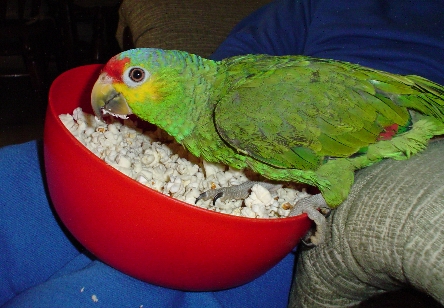
tequilapalomitas.jpg

The question I’d just asked was about his preferred foods. I was secretly hoping to hear that he ate a sunflower seed only diet, because this is the pinnacle of poor nutrition for the average parrot and was quite popular 30 years ago when most birds were imported and went through the rigors of quarantine stations before finding their way into homes. Thousands of parrots seemed to subsist on sunflower seed alone, whose nutritional value, though high in protein and fats, was loathsomely deficient in calcium and other life-sustaining vitamins and nutrients. 

The secret card up my sleeve? African Grey parrots, both the Congo species and their smaller cousins the Tymneh, were unusually susceptible to severe sickness from hypocalcemia. In addition to building strong bones, calcium is needed for all muscle contractions, including the heart muscle, and low calcium led to seizures or tetany and cardiac arrest. The treatment was simply supplying calcium and a little vitamin D to the afflicted parrot and most would turn around. The stuff of miracles and who doesn’t want to see a miracle?

But this woman! What was she saying? Forget seeds. Her bird subsisted on caramel corn? Peanut M&M’s? Pizza? Impossible that this bird could survive the high salts and fats and sugars of this diet! Let alone live to 42 years of age. But here he was. Although, as I knelt to get a closer view, one could not say that he was “living.” Not yet dead was more accurate. Gingerly I opened the cage door and slowly pulled him out. Joe didn’t move. I finally placed my stethoscope to his chest without disturbing his position on the towel. Oh dear. He had a heart murmur and his heart was beating very erratically. Cardiac arrhythmia. His abdomen bulged ominously. A tumor? The case was hopeless. The bird had never been to a veterinarian before and this was clearly too little, too late.

Which I tried to explain to his owner. We could do diagnostic tests, but he might die while we were trying to help him. The tests would be expensive and some would take a day or more to get results. I didn’t think he’d live long enough to find out what was killing him, let alone help him. I hate cases like this.

Joe’s owner requested that we proceed.

We placed him in an oxygen cage. Then, using gas anesthesia, we let him breathe himself into a state of non-painful peace and took x-rays, drew blood, obtained culture samples and tapped his abdomen (abdomenocentesis). No tumor. Joe appeared to be in congestive heart failure. What’s more, he woke up. I had given him several medications while he was still out and he remained on supplemental oxygen. Fast forward 24 hours. Joe is standing, a little wobbly, and has lost 50 grams of retained fluid overnight (10 percent of his entry weight). His blood calcium test is normal. Too weak to eat well on his own, we gavage fed him, using a tube to place baby mush directly into his crop. Fast forward 72 hours. Joe is talking, grooming himself and cracking seed. We take him off oxygen. On Day Five I sit down with his owner and explain that against all odds, her bird is adjusting well to oral medication and can go home. He will need medication the rest of his life. Given the seriousness of his condition, I tell her each day is a blessing. This is good enough for Joe and his owner.

We stayed in touch. Joe continued to improve. On Day 10 his owner happily reported that Joe was eating caramel corn again. Tongue-tied, I pulled back and stared at the phone. Not the goal I had in mind. I kept quiet. It’s been more than one month since I first met Joe. He is doing very well on his heart medications. I may start eating caramel corn myself.

Christine McFadden, DVM

Send questions or comments to drmc@mcmenagerie.com

Dog flu has been reported in the Valley. Here’s what you need to know.

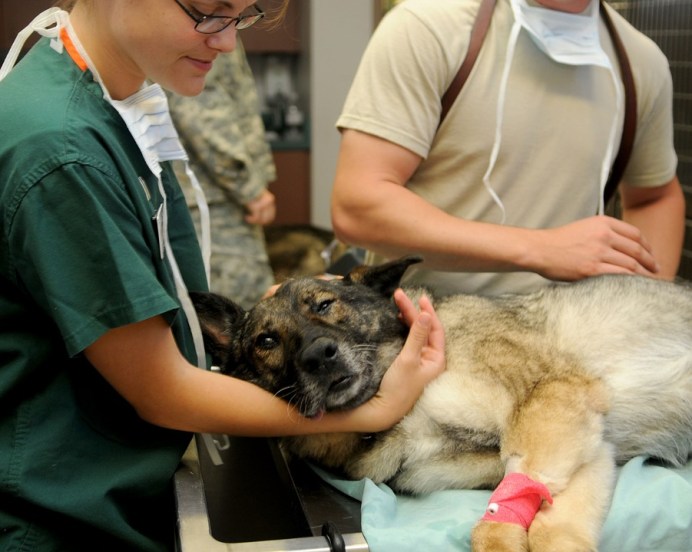
Serious news for all dog owners in recent weeks, folks: Canine influenza, or dog flu, has been documented both in San Francisco and the Bay Area and in Fresno. Up to 50 cases were diagnosed in the Bay Area in mid-January, with a confirmed case in Fresno announced Jan. 24.

holding-dog-head-e1519278244598.jpg

This dog flu is highly contagious between dogs, with 80 percent of all exposed dogs becoming sick. Most of these dogs will be only mildly sick. Symptoms include coughing, sneezing, runny eyes and noses. Some dogs whose respiratory system has been attacked by the flu virus will develop secondary bacterial infections and have thick purulent (pus) discharge from their nose and a very high fever. Occasionally even pneumonia can occur and in rare instances, death.

You’ve all probably heard of “kennel cough,” which is a generic name for a variety of viruses or bacterial infections that cause a cough contagious to other dogs. The actual cause of bronchitis can only be determined through tests. An oral cheek and eye tear swab can be sent to the lab for a PCR test (polymerase chain reaction – if you really want to know more on that kind of testing, please research!) When last checked, a PCR upper respiratory test in dogs looks for up to 13 different viruses and other agents, including both forms of the Canine Influenza, H3N8 and H3N2. Dogs in close contact easily spread the germs by coughing on each other – in a kennel, a grooming parlor, at a dog park, day care or shelter. Anywhere dogs meet. In addition the flu virus can be spread by contaminated objects like food or water dishes, collars and leashes.

Should your dog contract canine influenza you will need to see your veterinarian. Treatment is tailored to symptoms and whether secondary infections are a concern. All affected animals should be isolated from other pets for 1 month to prevent the spread of this disease.

Canine influenza first made headlines in 2004 when several racing Greyhounds dropped dead in Florida. This was the CI H3N8. It wasn’t until March 2015 that there was another crisis when an epidemic broke out in dogs in Chicago. This was a different form of CI, H3N2. They thought part of the reason for an outbreak in a big city had to do with large concentrations of dogs moving through airports. The dog flu has not been widespread and risk to pets in many parts of the U.S. has been low.

The dog flu H3N2 has been known to affect cats. One outbreak occurred in cats in a high-stress shelter environment. No cats are known to have died from the canine influenza viruses, and there is no approved vaccine for cats.

Canine influenza viruses have not been found to be transmissible to humans.

Should you like more information on the canine influenza viruses please look up the American Veterinary Medical Association article on-line. Your local veterinarian has information and protective vaccine available to your pet. This bivalent vaccine protects against both strains of dog flu. Two vaccinations are required to start, given approximately one month apart, and can be started as young as seven or eight weeks of age. Because it takes a month for your pet’s body to mount a complete immune response, and given the closeness geographically of the epidemic, we recommend all dog owners contact their veterinarian to start protection. Be aware that like the Bordetella vaccine (a better known “kennel cough”) and human “flu shots” even with proper vaccination your pet might contract a mild case. Many area clinics are offering the vaccination to their regular patients. Simply put, we want to protect your pets. We’re here for you.

Christine B. McFadden

drmc@mcmenagerie.com

The Large Animal Vet


Perhaps the title sounds misleading. A “large animal” vet develops a veterinary practice caring for the needs of livestock such as cattle (dairy or beef), sheep, goats and pigs. A “small animal” veterinarian like me is usually slotted into the care of companion pets such as dogs and cats. So when I examine a 200 pound dog, it is still a small animal and likewise there is often confusion about whom to call when the patient is a pot-belly/miniature pig. Not me.


The life of a small animal vet and that of a large animal practitioner are markedly different. One works almost exclusively indoors, dressed neatly, white coat in place. The other weathers life outdoors, facing extremes of blazing heat to icy cold, rain and snow. One always has a sink handy to tidy up. The other uses outdoor hoses more than they’d like. A dairy vet may check over 100 head of cattle in a morning and four “farm calls” make a full day. A small animal vet may follow the medical strands of more than 25 patients a day, winding through exams, blood results, x-rays and working in a surgery or two.  All juggle the demands of unexpected emergency work.


Being in an office most of the day, I rarely interact with my brother and sister large animal veterinarians. So when the pygmy goat from the petting zoo fell over dead I was unhappy, but proceeded to perform a post-mortem examination and sent tissue samples off to our regular lab. I had overseen the care of these goats for many years, but they were on the back burner when it came to my interest in the truly exotic Zoo collection. My concerns centered on whether or not the public might have fed something odd to the goat? (I’ll jump ahead here : No. The public did not harm the goat). I mulled over the problem but prepared to wait until the pathology report was finished sometime in the next week. And then another goat died.


I was unnerved. The goats were being closely watched and none had shown any outward signs of sickness. They had all lived for more than 8 years at the Zoo and had never, collectively, suffered a single injury amongst themselves. I immediately sought the expertise of a Large Animal veterinarian. The Goat Expert was on a dairy farm. The return call came in as I was finishing one surgery and about to start another. Gloves still on, I was staring at some x-rays

in-between these surgeries when they told me they had Dr. B on the line. Multi-tasking at its best.


I hurried over, snapping gloves into the waste receptacle and grabbing pen and paper. I introduced myself and LAUNCHED into a recital of my goat woes. I verified that he had goat experience? Yes. I gave him dates, genders, date of deaths, lack of lab results, still pending. I drew breath to spew forth another list of details and heard him gently respond, “Yes…. I think…. I might be able…. to help”. His measured tones were from a man used to the gentle rhythms of milking machines, contented cows swishing their tails, chewing their cuds. Da-dum da-dum to my staccato dop-dop-dop-dop-dop! I managed to squeeze in a few more hurried sentences (surgery! Waiting!) before he responded calmly, “I think I drive past your practice on my way up from this dairy….”. I opened my mouth. Closed my mouth. I could hear the clouds, feel the sunshine, almost see the shining black and white hides of the gentle Holsteins he surveyed as we spoke. It was all there in the rhythm of his speech. I told myself to stop yapping before he decided my goat problem would be too stressful for him to bother with.


An hour later Dr. Thomas Bauman drove up in a large truck outfitted for all manner of veterinary ministrations. He spent an hour and a half doing a post-mortem on one goat. He had a wicked knife and mulled over the cause of sand in the stomach. He felt it was too much. Did we feed on the ground? No. But little kids feed the Zoo goats oat hay pellets and they often dropped to the sand, with all the goats scrambling to get their share. Hmmm. He gave the problem his full attention and we submitted a gazillion samples to the State Lab, including an intact eyeball because it would be useful for trace metal analyses. The final answer was a copper deficiency in the feed, to which Pygmy goats are especially susceptible. Hay grown in the San Joaquin Valley is often deficient in copper. The salt lick fed at the Zoo did not have added copper because Alpacas are in with the goats and they are susceptible to copper toxicity (too much) if supplemented. So we now feed our goats little capsules of copper wire every six months and all is good. But sometimes I find myself wishing that I was a Large Animal veterinarian. Just so I could slow down and smell the …..never mind.


Christine B. McFadden, DVM

drmc@mcmenagerie.com

Walking Your Dog

Walking the dog is good exercise, good for the dog, good for the family. Done properly, you take in some sunshine and fresh air. You have time to admire the blossoming trees and critique your neighbor’s landscape. Wait a minute, there’s a “proper” way to walk your dog? Hmmmm…


Young puppies need exercise to build strong bones and muscle. Psychologically their mind will be more focused if their body is relaxed after a good run. Good manners and obedience training is then maximized. The average dog needs 30 to 60 minutes of hard exercise every day – not just a leashed walk around the block. Some breeds, like hunting breeds bred to run for hours, may need more exercise than a breed bred to be a lap dog. Different personalities require more exercise to tire. Know your pet.


Because of the high prevalence of canine Parvovirus infection locally, all puppies should have received three or four vaccinations for this and Distemper by four months of age before hitting the streets of Merced.

walking dog.jpg

Dogs that do not receive adequate exercise are often bored and that pent-up energy can turn into destructive habits: tearing up furniture and household items, digging up the back yard, constant barking. Yech! No wonder you see those ads for free dog, needs big back yard.


As your dog grows older his or her exercise needs change, especially if your pet has any health issues. Arthritis is as common in older dogs as in older people, and regular exercise is even more important to keep them moving. You can fall into a vicious cycle : it hurts to walk, so you let your dog stay home and sleep. His muscle tone deteriorates further and can’t carry the weight of his own limbs. Muscle atrophy occurs, and now your dog walks bone-on-bone. This is where regularly scheduled daily exercise helps to keep that muscle tone built up and will improve your dog’s mobility. This is also a good time to consider working with your veterinarian to consider arthritis medication options, customized to your dog’s kidney and liver function. Your vet will review with you dietary options, over the counter supplements and anti-inflammatory and analgesic (pain) medications. Working together we can optimize your dog’s athleticism and enjoyment of life well past what used to be achieved.


Explore the lovely foot paths along Bear Creek and Black Rascal Creek. Merced neighborhoods enjoy our climate by showcasing flowers throughout most of the year. Clean up after your pet’s waste, don’t let your dog soil someone’s yard. There are many handy gadgets available today to make the minor chore quick and easy.


Please review the weather before setting out. The Valley rarely suffers severely cold days but there’s no denying that our summer weather includes many scorching days over 100 degrees. Feel the asphalt with your palm. Even after the sun has gone to bed, you may find the road too hot for doggie feet. They aren’t walking on rubber-soled athletic shoes that insulate their feet from the baking asphalt! Early mornings are most cool for pet and people if you can motivate yourself to get out there and enjoy our sunrise.

I feel I must add a word of caution to all would-be dog walkers and perhaps especially to parents of young children who wish to take the dog for a walk. Dogs attract other dogs. Your pet may be walking obediently on a leash, minding its own business and another dog or dogs may come from nowhere. These loose dogs may attack your dog. If you try to intervene they may leave your dog to attack you. Some of my clients walk their dog and carry a stout walking stick for possible defense. Some carry pepper spray but I have heard that it is often ineffective on dogs, not to mention you must be close enough to aim for the eyes. An inventive scheme is to carry an umbrella, and if a stray approaches rapidly open and close the umbrella to fend off an attack. Loud noises, such as produced by an air horn, could also frighten away a dog. Always stand your ground and face an approaching dog, saying “NO” in a loud, commanding voice. Hold your hand out firmly in the universal gesture for “Stop!” Do NOT scream and jump around as you have now become prey. Should your dog actually be attacked do NOT use your hands and arms to try to pry them apart – every year I have a client or two sent to the hospital when the attacking dog turns upon them (or their own dog bites them, frenzied as it tries to protect itself). Only a stick, a broom, a chair, some kind of physical object can be used to wedge the dogs apart. Know your neighborhood. Do not walk your dog near homes with chronically loose pets or dogs that bark viciously along the fence line and might jump over.


Taking a walk has benefits that far outweigh the risks. Get out and enjoy our spring!


Christine B. McFadden, DVM

drmc@mcmenagerie.com