Saying goodbye to Mac the Mountain Lion

Mac the Mountain Lion died Saturday night, October 13th.

He was wearing spots when I first met him. One of two foundling cubs, Mac was the lucky one. The sibling he was cuddled against had already died. He barely weighed 5 pounds.

At the Applegate Park Zoo, the little orphan was bottle fed by Donna, the head zookeeper. We all fell in love with him. Mac created a stir when he came to the clinic for his health exams. He had a trilling call that was most like the whistle of a firework headed skyward, before the explosion. It was lovely and wild and totally magical. It was fascinating to watch him grow.

His last “kitten” vaccinations required advance strategic planning. Donna withheld his milk, bringing him in close to feeding time. I quickly jabbed him with the needle while she simultaneously dropped the bottle into his mouth — success! Although only 36 pounds on that day, his “playful” paws were already tools to be respected. In fact, in only a few short weeks he shed his spots and took up the very important cat sports of swiping, stalking, and stealth.

Donna was Mac’s first love, his “Mama”. If he heard Donna’s voice he would come running, rubbing against the fence so she could scratch behind his ears, sending out a gruff “meow” in answer to her calling his name. All day long he would “sing” to her. The noise he made as a young kitten was long gone, replaced by his loving meow or an unearthly scream.

A mountain lion is a truly magnificent animal. He is the fourth largest cat in the world. Their territory ranged across all the Americas. Deer are their preferred dinner.

A solitary and shy individual, the mountain lion is not drawn to humans and rarely seen. One of the reasons that Yosemite National Park strongly urges people not to feed deer is to prevent their unnatural accumulation which in turn attracts their natural predator — the mountain lion. If a mountain lion is lured by the prospect of an easy meal to an area heavily inhabited by people it may be seen as a threat. For the lion, it risks death as a “nuisance,” the only reason a mountain lion may be hunted or killed by man in California since 1990. The Miwok Indians, Native American people of California, described the mountain lion as the ideal hunter, strong and brave, chief among the animals (quotation from the Mountain Lion Foundation; Montijo,Y).

In late October 2016, Mac ate part of a fireman’s hose that had been given to him as a toy “scratch pad” for enrichment purposes. The little darling (Mac weighed about 140 pounds) shredded the 40 pound hose and ate it instead, forcing an abdominal surgery, a gastrotomy, to remove the obstructing foreign object from his stomach. His recovery was rapid and he continued to thrive. But Mac always had a sneaky habit of eating things he shouldn’t.

When the first call came in late Saturday morning that Mac had thrown up I wasn’t too concerned. Always on top of things, the zookeeper who called me was keeping me informed. I said I would come by later and look him over (“look” in this sense is all that I could do — without an anesthetic I couldn’t examine Mac in any physical way.

Within a few short hours it became obvious that Mac was seriously ill. Under sedation, the picture looked grave. Running a fever of 105.6, Mac was septic and shocky. Another intestinal problem. We took him to surgery. Terrible news: something had perforated Mac’s intestine. This hole through the intestinal wall allowed leakage of bowel material into his entire abdomen, creating an overwhelming infection called peritonitis.

The normally clear fluid inside the abdomen was a murky brown color, spreading infection everywhere. The prognosis was poor. But we had to try. This was Mac.

I performed an intestinal resection, removing the section of intestine that had the hole in it. We lavaged his abdomen with liter after liter of sterile warmed saline to flush out all the infection. After several hours of surgery, we prepared to recover Mac and return him to the zoo. But it was too much for him — the septic shock overtook him and he simply stopped breathing. At 12 years of age, Mac was gone. Mac’s majestic presence will be missed at our zoo.

In “Cougar: The American Lion” by Kevin Hansen, he reports that in the mythic world, the mountain lion was the protector of the cosmos. The Zui of New Mexico said that the ancient ones wanted the world to be guarded by those keen of sight and scent, and the mountain lion was the sentinel of the North. I like to think of Mac up there, protecting our cosmos, immeasurably extended over time and space, the Milky Way and far off galaxies.

Christine McFadden holds a license to practice veterinary medicine and surgery. She has cared for the family pets of Merced at Valley Animal Hospital for more than 30 years. Send questions or comments to drmc@mcmenagerie.com
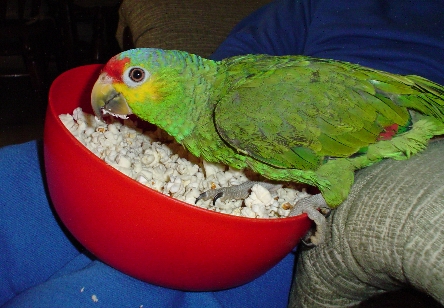

The Parrot Who Ate Caramel Corn / Heart Failure

Unbelievable. If I dared roll my eyes during an interaction with a client, my eyes should have been doing cartwheels during the intake history I was noting on the chart.

My patient, an African Grey Parrot named Joe, was lying face down in his carrier, his beautiful red tail inelegantly dragging in the muck and mire. I was afraid to handle him, for fear it would push him over the brink. As I stalled for time I observed him from a safe distance, thoughts milling through my head. It creates a poor first impression when you touch your patient and he falls over dead.

tequilapalomitas.jpg

The question I’d just asked was about his preferred foods. I was secretly hoping to hear that he ate a sunflower seed only diet, because this is the pinnacle of poor nutrition for the average parrot and was quite popular 30 years ago when most birds were imported and went through the rigors of quarantine stations before finding their way into homes. Thousands of parrots seemed to subsist on sunflower seed alone, whose nutritional value, though high in protein and fats, was loathsomely deficient in calcium and other life-sustaining vitamins and nutrients. 

The secret card up my sleeve? African Grey parrots, both the Congo species and their smaller cousins the Tymneh, were unusually susceptible to severe sickness from hypocalcemia. In addition to building strong bones, calcium is needed for all muscle contractions, including the heart muscle, and low calcium led to seizures or tetany and cardiac arrest. The treatment was simply supplying calcium and a little vitamin D to the afflicted parrot and most would turn around. The stuff of miracles and who doesn’t want to see a miracle?

But this woman! What was she saying? Forget seeds. Her bird subsisted on caramel corn? Peanut M&M’s? Pizza? Impossible that this bird could survive the high salts and fats and sugars of this diet! Let alone live to 42 years of age. But here he was. Although, as I knelt to get a closer view, one could not say that he was “living.” Not yet dead was more accurate. Gingerly I opened the cage door and slowly pulled him out. Joe didn’t move. I finally placed my stethoscope to his chest without disturbing his position on the towel. Oh dear. He had a heart murmur and his heart was beating very erratically. Cardiac arrhythmia. His abdomen bulged ominously. A tumor? The case was hopeless. The bird had never been to a veterinarian before and this was clearly too little, too late.

Which I tried to explain to his owner. We could do diagnostic tests, but he might die while we were trying to help him. The tests would be expensive and some would take a day or more to get results. I didn’t think he’d live long enough to find out what was killing him, let alone help him. I hate cases like this.

Joe’s owner requested that we proceed.

We placed him in an oxygen cage. Then, using gas anesthesia, we let him breathe himself into a state of non-painful peace and took x-rays, drew blood, obtained culture samples and tapped his abdomen (abdomenocentesis). No tumor. Joe appeared to be in congestive heart failure. What’s more, he woke up. I had given him several medications while he was still out and he remained on supplemental oxygen. Fast forward 24 hours. Joe is standing, a little wobbly, and has lost 50 grams of retained fluid overnight (10 percent of his entry weight). His blood calcium test is normal. Too weak to eat well on his own, we gavage fed him, using a tube to place baby mush directly into his crop. Fast forward 72 hours. Joe is talking, grooming himself and cracking seed. We take him off oxygen. On Day Five I sit down with his owner and explain that against all odds, her bird is adjusting well to oral medication and can go home. He will need medication the rest of his life. Given the seriousness of his condition, I tell her each day is a blessing. This is good enough for Joe and his owner.

We stayed in touch. Joe continued to improve. On Day 10 his owner happily reported that Joe was eating caramel corn again. Tongue-tied, I pulled back and stared at the phone. Not the goal I had in mind. I kept quiet. It’s been more than one month since I first met Joe. He is doing very well on his heart medications. I may start eating caramel corn myself.

Christine McFadden, DVM

Send questions or comments to drmc@mcmenagerie.com
The Water Cycle

Kids say the darndest things! This year “The Water Cycle” is being taught in Science at the high school, which came to my attention when a story was relayed to me the other night.

rainboots

It had been raining, and the young man was quite anxious. “It’s raining!” he exclaimed. “Yes, yes it is,” his teacher agreed. Drawing closer, he whispered, “Do I smell like pee?” Backing up, his teacher stared at him. “What are you talking about? Of course not!”

The student went on to explain his thought processes. He fully understood the Water Cycle and its importance to Earth’s replenishing and sustainability of its water sources. Taking it a step further, he reasoned that all the animals urinate outdoors – dogs, cats, horses and cows, bears and raccoons, all the wild birds, even the insects and fish. Well (his eyes widening), all that urine must leach into the soil and evaporate just like water! Which meant it was now returning to earth and raining urine on his head.

Having never thought this through to this degree I stopped to ponder these ideas, searching for merit. His teacher, I might add, did no such thing. She told him the clouds filtered out impurities and the rain was clean and he could retake his seat. He was most relieved. I was impressed at her quick-witted response. This is where the scientist in me gets bogged down. This is why I’d be a lousy teacher.

So, the Water Cycle, in its simplest form, explains how water covers 71 percent of the Earth’s surface. This water cycles through several steps: It evaporates into the atmosphere, where it condenses into droplets that form clouds and later falls back to the earth as precipitation (rain, snow, hail, sleet), which is collected or returned to our oceans, lakes and land.

Next, urine from mammals is composed of about 95-percent water plus some other compounds, including urea. Urea contains nitrogen. This fact is very important to a different science lesson, the Nitrogen Cycle. Nitrogen is necessary for all life as the building block of protein, which both plants and animals need to grow. Nitrogen is the most important nutrient that plants get from the soil. The soil receives this nitrogen in two ways – nitrates come from animal solid waste like manure. From liquid waste like urine comes urea. Another way nitrogen is acquired is through decomposing into the soil.

Birds and reptiles are uricotelic (I wrote this whole story so I could prove I know that word), meaning their urine waste is in the more solid form of urates (that white stuff in the bird’s droppings) than liquid urine. It’s simply how their non-mammalian rudimentary kidneys function.

This is a very long-winded way of explaining that only the water from body wastes can evaporate into the air. All the “impurities” or other compounds are left behind to enrich our soil. Rainwater is essentially distilled water, free from impurities unless it picks up local air pollution/ dust or other debris as it returns as precipitation during the Water Cycle.

This is the most amazing win-win ever! So put on your galoshes and go splash in some puddles!

And have a great day!

Christine McFadden, DVM

Send questions or comments to drmc@mcmenagerie.com.

The Pancreas

Dr Mc Blog

July 28, 2015
Don’t you wonder how some things ever came to be named? Now the word “pancreas” comes from an anatomist named Ruphos of Ephesus, around 1 or 2 AD. In Greek pancreas means “all flesh”. And it IS a pale pink scrawny L-shaped ribbon of an organ sitting in a crook of small intestine near the right side of the stomach wall. Nothing you can really get your hands on during surgery. In fact, you don’t WANT to get your hands on it during surgery. The pancreas is notoriously sensitive to rough handling and maybe handling of any kind and as a young surgeon I worried that if I had to gently nudge it to one side to access some intestine or heaven forbid hooked it when trying to locate a recalcitrant uterine horn (uterus) during a spay surgery that my patient would have a belly ache for days afterwards or maybe die. That part turned out to be not so true but even after 30 some years of exploring abdomens I am still skittish about handling the pancreas and try to avoid any surgical contact.

So what does a pancreas do? The pancreas serves two very important yet distinctly separate functions in the body. One is an endocrine (hormonal) function, as the pancreas produces the hormone insulin. When this system runs amok, pets suffer from diabetes mellitus, often called “sugar diabetes”. The other cells of the pancreas exert exocrine (enzymatic) control and produce amylase and lipase, two enzymes that help digest food in the small intestine. When these exocrine cells malfunction, the digestive enzymes are released willy nilly into the pancreas, not the intestine, where they start to digest the wrong thing. This is the disease Pancreatitis. Inflammation of the pancreas and surrounding abdominal tissue as these enzymes eat away at it is so marked that it may be seen on an x-ray. Tremendous pain over the anterior abdomen is often present. The pancreas is most stimulated to produce its digestive enzymes by high fat foods and protein.

Kahlua was a doggie princess. A little pudgy in middle age, she was lovingly treated to her fair share of dog food and table goodies, often high in fat. One day she started to vomit her dinner. She was sluggish and screamed in pain when her owner gently picked her up around her tummy. In our office she was running a low grade fever and cried when her anterior abdomen was palpated. Among her blood tests a special test for pancreatitis, the Spec Cpl (specific Canine pancreatic lipase test) was positive. Both amylase and lipase scores were in the thousands. When we told her owner the news he was ghastly quiet. Finally he raised his eyes and told me quietly that he had just lost his wife to pancreatic cancer. Kahlua was all he had left of her. He didn’t need to say more. I couldn’t rule out cancer that early because there is no blood test to rule out cancer of the pancreas. If cancer is present, it may be the size of a small pimple and won’t always show up on an ultrasound scan. We would have to proceed with standard treatment for pancreatitis and if Kahlua did not improve as expected would review our other choices. After several days on intravenous fluids to flush out her body and absolutely no food (do NOT want to stimulate the pancreas during this time!) Kahlua brightened up considerably and was no longer painful over her tummy. Her signs of infection responded well to antibiotics and when we gave the all clear and offered a tiny meatball of a bland low fat food she gobbled it down and never looked back. Despite this brush with serious disease Kahlua never had another problem with her pancreas, though she did maintain a low fat diet for the rest of her long life. She was another lesson in proceeding cautiously when discussing any particular ailment of a pet that humans might share, as all too often I find that my diabetic patient has a diabetic owner, or that heart disease or cancer “runs in the family”. Kahlua was 7 years old when she developed pancreatitis and lived another 10 years beyond that, a princess to the end.

Christine B. McFadden, DVM
drmc@mcmenagerie.com