Stayner and Queenie (A Boy and His Dog)

On January 23, 2019 the Merced Sun Star newspaper printed a front page photo that showed both of the Stayner boys together in 1980, shortly after Steven Stayner had been reunited with his family. Steven’s story was remarkable. Steven disappeared when he was 7 years old, simply vanished from his neighborhood one day. It was 1972. Missing for over 7 years, he was reunited with his family only after his captor kidnapped a second child. Steven couldn’t endure seeing this child’s anguish and he hiked the little boy out to a police station. Although rarely mentioned, he also brought with him a dog. The child Steven aimed to rescue ultimately led to his own rescue. It was an incredible story, one that mesmerized the nation. This photograph, taken during the family reunification, shows Steven with his older brother Cary and their father, Delbert Stayner. The portent was only realized in hindsight : one brother, Steven, had saved a life.  Sadly, Steven died an untimely early death in 1989. Ten years later, in 1999, his older brother Cary Stayner was to gain notoriety for committing the unbearable murders of four women. Overall, a very grim and sad story for the family and the town of Merced.

This was a rare photo that captured both Steven and his older brother together, a moment in a time of celebration. But my eyes saw only the dog. Hey! What about Queenie? That’s a picture of Steven and his DOG! She’s right there, just to the side of Delbert Stayner’s elbow! A little black dog with tan legs, Queenie had been with Steven throughout the years of his captivity. She looks happy in this photo, bright eyed.         (Link to Photo from Modesto Bee Here)

I’m a veterinarian. Of course I noticed the dog. That and – I knew Queenie, knew them both, she and Steven. I knew them because I took care of Queenie at her life’s end. That was many years ago. Her importance was to Steven, her passing private. I share a bit of this story because in today’s world we talk about the “human-animal bond”. We use scientific methods to analyze the effects that animals have in sharing our lives. C’mon people – it’s simple : love.

Queenie. Steven was very young, only 7 years old, when he was torn away from home and family. Queenie entered his captive life early on and remained a constant throughout the years to follow. She gave him unwavering loyalty, and non-judgmental constant cheerful companionship. It is notable that when he left that night to return the little boy, Steven never considered leaving his dog behind.

I met Queenie and Steven in late 1982 or early 1983. She was very ill. The little dog looked thin compared to her bloated abdomen. Steven was very quiet. A polite young man, he desperately wanted to save her. I think, in many ways, she had saved him.
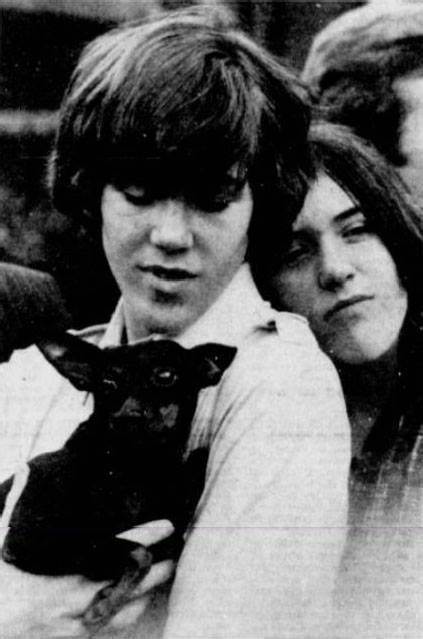
Queenie’s abdomen was enlarged due to fluid build up, a condition called ascites and often caused by liver failure. Back in the early 80’s, blood tests, ultrasounds and other diagnostic tests were not readily available in the Central Valley. Neither was overnight care. I lived in Turlock and commuted to my job in Merced that year. So I started Queenie on IV fluids and other medications and drove her home with me that night. I rigged her IV fluids first to my car door strap, then used a coat hanger to suspend them from a towel rack. She was a sweet dog, but had no energy left to fight her illness. Queenie passed away quietly in my living room at home in Turlock. Steven took her from me the next morning. Although no autopsy was performed, I believed she had liver cancer.

Although I saw Steven with other pets after that, we did not have a personal friendship and I lost touch with him over the years. The love that he and Queenie had for each other has stayed in my heart and I was touched to see her once again, that doggie laugh on her face as she forever follows the love of her life, Steven.

Christine B. McFadden, DVM

drmc@mcmenagerie.com

My Husband’s Hospital Vacation

My first indication that text messaging had gone too far in my household was the afternoon I checked my phone and discovered the following message : “Just wanted to let you know. I thought I might be having a heart attack so I checked myself into the hospital.” It had been sent from my husband’s cell phone.


What you need to know were the events preceding this text message. My husband had taken our children skiing two days earlier. On this morning, he had done some moaning and groaning around the house. The problem is, I not only have to get ready for work myself, but I oversee care of the kids, the cats and the chickens before leaving. Getting to school on time is a mountain we climb every day. If it’s not worth opening your mouth to speak up about something, I’m not going to slow down long enough to start an inquiry. He knows where to find his Advil.


I confess I felt more irritation than anxiety when I read the message. Really? I’d had a full day and no lunch up to that point. So I called him. He answered. He sounded cheerful. Enough hours had passed before I’d discovered his message that he could assure me that his chest x-rays, his blood tests and his EKG were all normal and he wasn’t having a heart attack. So why are you still there? I reasoned. Well, he rambled on, this doesn’t explain the pain. “What about arthritis?” I asked. Oh no, he assured me, I’ve never had arthritis here. It’s on my right side. I was driving myself to the golf course and felt pain in my right arm, so I pulled over and googled heart attacks. It said they would be on the left side, but I thought I should be sure. They’re going to run another test to see if I have blood clots. If it’s abnormal, I’ll stay for a CT scan.


OK, honey. I returned to my own patients. There was a cat that had been tumbled in the dryer for 7 minutes. She appeared dazed, with tiny bruises starting to appear on her skin where patches of fur were missing. She was a lucky cat; only last month, another cat had actually died in a similar accident. We began treatment for shock and started the cat on IV fluids.


It was closing time when my husband called. My test is abnormal, he said. “What’s the name of that test, hon?” D-Dimer. We use the D-dimer test in veterinary medicine. Platelets, the cells that help blood coagulate or clot so you don’t bleed out, will slowly break down after they’ve served their purpose. If your body is forming big blood clots where it shouldn’t, the by-product of platelet breakdown will be very high in the blood stream. The D-dimer test measures this level.


For a variety of reasons, I didn’t believe it. So while getting the kids squared away I researched the normal blood levels for humans. Armed with this info, I went down to visit my husband in the ER. He looked remarkably fit. In fact, he wasn’t feeling any pain, though he’d not been given any medication. I asked his nurse for the actual number on his D-dimer test. It was less than 200. I stared at the nurse. “But that’s normal”. Yes, the nurse agreed. I stared at my husband. “Who told you it was abnormal?” He frowned, concentrating. He wasn’t sure (What else did he have to do?). About then they came to wheel him down for his CT scan. They said it would be read that night. Forgive me my skepticism, but having assured myself that my husband was doing very well, I kissed him and told him to enjoy his scan. At this point I reflected that if they did find something wrong with him, it would not be what he’d gone in for. I slept poorly (despite my brave front). At 2:20 in the morning (5 hours later) my husband sent a text message that he had completed his CT scan but it wouldn’t be read until the next day.


I visited him on my way to work the next morning. He was cheerful and even complimentary on the hospital breakfast. They were going to run some more blood tests. I left him to it.


At work, my own patients were well. My dryer tumbled cat looked much better and was enjoying a hearty breakfast herself. Her bloodwork was excellent. By early afternoon I was discharging my patient to her ecstatic owner. Back at the human hospital, my husband had been leaked the information that he had a “non-displaced hairline fracture in his right rib”. My husband was now being offered an echocardiogram and had begun to call me every hour or so. I told him if he couldn’t relieve the babysitter by 3:30 to let me know. If he wanted to stay another night in the hospital that was on him. I was worn out.


Once he knew it was just a cracked rib, my husband felt lots better. I arrived home that night to find he had invited several people to dinner and cooked up a storm. Even better, he could go on his golf vacation next week.


I am SO grateful my patients can’t talk!


Christine B. McFadden, DVM

drmc@mcmenagerie.com

Castor the Police Dog

There are many fine working dogs out there – cattle and sheep dogs, Guide Dogs for the Blind, Special needs assistance dogs, Bomb and Drug dogs, and perhaps one of the finest working groups, the Working Police Dog, or K-9 Cops, complete with their own badge. Hired on by Police and Sheriff departments nationwide, they are largely made up of German Shephard and Belgian Malinois breeds. I have had the honor of working with these dogs for over 30 years. Both local Police Department and Sheriff’s Departments have working dogs, used on the SWAT team, for school protection, building searches, drug deals and of course, criminal apprehension.

Astor was a beautiful sable shepherd. High strung, as so many of these dogs need to be to perform their job, ever alert, he suffered from stomach issues, and his spleen would swell to enormous proportions. We had just gotten in 4 new dogs at the Police Department, and one had already been rejected for a permanent lameness in the right shoulder and returned to the seller. This was at great expense and nerve wracking for the new program. To have problems with another dog was near unbearable. I said he needed to have surgery, to biopsy the intestine and spleen. It was late in the day when his handler came down to visit him in recovery. Though the individual police departments own the dogs, it is their Peace Officer Handlers that live with the dog and develop an intense bond. These dogs – and their handlers – were new to me and I knew very little about them. I was ignorant that even off duty an officer is expected to be prepared to respond to an emergency, so when the handler bent over in post op to greet his dog, I was most startled to note a gun in his waistband! I wondered if he’d planned to shoot me if the surgery hadn’t gone well! (He said no).

Most of the dogs have German names, as many were and still are imported from Germany. Their commands are given in the German Schitzhund or obedience training language. Handlers lucky enough to be assigned a partnership with one of these dogs will spend weeks learning the cues and training required while forming a deep bond. You see, these dogs can go where a person cannot. These dogs serve as the first line of defense when things go bad. No one wants to lose a dog – but better the dog than a Peace Officer. The K-9 Cop can mark a perpetrator in a crowd and run him (or her) down. Once the fleeing person stops, they will stand still, not biting unless the person resists and provokes a bite. They can be sent into buildings with cameras on their backs to locate the offender. They can smell or hear where someone is hidden.

Castor was a Malinois from the Sheriff’s Department. He passed away naturally some years ago. A very “sharp” dog, he was a holy terror when he came into our clinic. He growled at all the staff. He was not walked during his brief stays, as we customarily do with all boarding pets. Except….Castor loved me. There was no rhyme nor reason to it. I poked him with needles, gave shots, drew blood. No problem. At first I wondered if I resembled the handler’s wife, but once I met her, blonde, petite, beautiful, sadly I knew that I did not. Whatever the reason, I was grateful. Castor had many arrests to his name, but my favorite story was the guy swimming in the canal to elude capture. His handler sent the dog, knowing if the guy made it to the far bank he might get away. The criminal decided to drown the dog. Castor took matters into his own hands, simply wrapping his jaws around the only body part he could reach – his neck. The man surrendered.

In the United States Air Force, fighter pilots are accompanied by a “Wingman”, another fighter plane which flies off the right wing and just behind the lead, whose job is primarily to protect the lead by “watching his back”. Our Canine Corps of Peace Officers serve as “Wingman” to the officers they shadow.  May we be humbled by their gifts and grateful for their service.

My Christmas-motif salad wreath emoji

My staff said they needed to speak with me this afternoon. Well, of course. Had we not just enjoyed a dinner and dancing together on Saturday to celebrate the holidays? I met their loved ones. We shared food together. There were contests and prizes and drinkable holiday cheer and overall it was quite the festive occasion. With a day in between to recuperate, everyone was at their sparkly best back at work.

Monday started with a raccoon from the zoo. Her swollen cheek was returning to normal and no abscessed teeth were found, so we shipped her back to the zoo. We tackled two broken legs, a cat and a Great Pyrenees puppy. Both are expected to heal. We saw several birds. One, an enormous 30-year-old Blue and Gold Macaw parrot, screams the entire time we work with him. Oh, sorry, you heard him, too? My ears are still ringing. He was having his annual exam and a nail trim, for pete’s sake. We tended to an elderly rabbit whose x-rays revealed severe arthritis in the lower spine. We prescribed both an anti-inflammatory medication and one for nerve pain (neuropathy). We enjoyed a visit (with vaccinations) with a young Shepherd puppy that just found its Forever Home.

Good news arrived on another front : A 7 pound little stray with breast nodules and rotting teeth had been adopted. For Christmas this little dog not only found a Good Samaritan (shout out to the Stouts!) to address all of her considerable medical needs, but today the biopsy of the breast masses showed that they were benign! With no evidence of a deeper cancer, she can look forward to many healthy years to come. (Side note: I’ve said it before, but can’t help point it out again: Older unspayed female dogs run a 25-percent risk of developing breast cancer, usually malignant. Have your puppy “fixed” while she’s young to prevent this. It really is that simple.).

I fielded questions about pet snakes, lice on rats, a pet pig, and found time to do a little surgery. So when my staff flagged me down I slowed down to give them my attention. “DrMac, when you send an emoji on your phone, do you think you’re sending a Christmas wreath?” First I had to redirect my mind, away from veterinary medicine and onto “emoji”.

Just in case you’ve spent the last 20 years stuck in a Jumanji game, an “emoji” is a cute little symbol meant to convey a person’s thoughts or facial expressions or a symbol. Emoji’s can be inserted into a conversation during text messaging on the ubiquitous cell phones. You needn’t say you are happy, you can simply send a smiley face. Same with “sad”, “embarrassed” and a host of other feelings. These little cell phone symbols also pop up unexpectedly, as your “smartphone” detects the theme in a sentence and suggests a complementary emoji. A turkey showed up around Thanksgiving on my phone, and with the advent of the Christmas holidays, I noted a tree symbol pop up, trimmed in holiday ball ornaments, and another of a Christmas wreath.

So I began to include a Christmas tree in my text messages, whether or not it was pertinent to the conversation. I was being festive. As soon as I saw the wreath, I began to send that out, also, alternating one with the other.

On Monday afternoon this non-medicine related question came out of left field and I took a moment to adjust. Yes, I admitted, I’ve been sending out text messages with Christmas wreaths. I was puzzled.

Three of them began to howl, collapsing into themselves with laughter, barely able to sputter out “You’ve been sending salads!”

What?

The sad truth came out. Those tiny little colored balls decorating my “wreath” were cucumber and tomato slices. Worse, when the emoji was sent from my I-phone to an android phone, it transformed into a bowl of….salad. Not remotely wreath-like. Well, you can’t let little things like this get you down. I have now sent out a text to my nearest and dearest saying “Greetings! I’m sending you my exclusive Christmas-motif salad wreath emoji, which I mistakenly thought was the accompaniment to the tree….” So here’s to happy holidays to all and if I send you a salad wreath just enjoy it, ok? Related image Image result for salad emoji

Christine McFadden holds a license to practice veterinary medicine and surgery. She has cared for the family pets of Merced at Valley Animal Hospital for more than 30 years. Send questions or comments to drmc@mcmenagerie.com.

Marijuana Toxicosis

Now it is possible that some of you may succumb to the same little habit I am guilty of: reading the popular magazines while standing in line at the grocery store. Never buying them, of course. This is where I follow the stars (we aren’t talking astronomy here) and gather knowledge of my fellow human beings. Consider it human resource research. It doesn’t take many pages for me to feel that I have gleaned everything of interest that one of these magazines might offer, so imagine my surprise when I came across an entire page devoted to the subject of: “What’s In My Bag?” It is actually believed to be of interest to American readers to know what a Hollywood actress might carry in her purse. I am stuck on that: who cares and why? First, I decided to look in my own purse. I have one, though I rarely carry it.  Wallet, ID, keys. A pen. Sometimes I have actual money in there, sometimes not. I cannot imagine this being of interest to anyone else. Even potential purse snatchers have divined that it’s not worth their time.

Now, if I was going to be interviewed for a magazine with full page glossies, would I lie and embellish all that? You bet. Do people really carry extra shoes, whole bottles of water, and apples in their purses? Why don’t THEIR apples bruise after being jostled in a bag with shoes all day long? Are those shoes… gym shoes? Ewww. Is it possible that I am the only person in the world who doesn’t carry protein bars as their snack, sweetened preferably with honey or agave or stevia leaves, no white sugar please? Help! These women have no need for gym class – their purses are “free weights”. Crunches, curls, lunges -just lift and press that purse. The possibilities are endless.

One item missing from these lists of “What’s In My Bag” are marijuana products. Ooops, did I just say that? Hollywood has a bit of a rep for extreme partying, for a lifestyle of too many pills, alcohol, and drugs. Now that marijuana has been legalized in California I thought someone’s “Bag” might be the first place it would show up. So I’m happy they’ve shown restraint. I’m not very happy about marijuana, legal or not. Legalization has opened up a host of dangers for my patients, mostly the dogs.  As a veterinarian, I am appalled at the people who, through carelessness or on purpose, allow it to be shared with their pets. Over the years I have cared for several dogs that were “stoned”. Marijuana-laced brownies or other food items were usually the culprit, but about half the time the item was shared with the dog because their owner was high and thought their dog should be allowed to experience the same “joy”. The reason I saw the dog was because even in their fog, the owners recognized something was terribly wrong and sought emergency care for their pet.

A pet affected by marijuana toxicosis will exhibit a host of neurological abnormalities. Dogs may become so agitated they appear manic, drooling, dilated pupils, constant vocalization and walk uncoordinated. Seizures, coma and death may occur. There is no ready test at present to detect marijuana levels in a dog, so we must rely on the owner’s honest history if we are to help their pet. That said, there is also no true antidote – we must watch the dog suffer the effects, which we try to minimize and flush out the drug with IV fluids, oral charcoal, sedatives and  sometimes enemas. The active chemicals in marijuana are stored in body fat, broken down in the liver and exit the body in the feces. It can take 24 miserable hours or longer for your pet to recover. Some trip. I am not impressed.

Years ago, fatalities related to marijuana exposure were rare. Most pets ingested only small amounts of a natural plant, containing a relatively small amount of the primary psychotropic chemical THC (tetrahydrocannabinol). That is no longer true. You see, in developing medical-grade marijuana products they have synthesized and concentrated the most potent chemicals in marijuana. Pets that ingest these medical-grade products have a much higher risk of toxicity.

The American Veterinary Medical Association (AVMA) is undertaking research to see if there are any medical benefits to the non-hallucinatory, non-psychotropic chemical CBD (cannabidiol) that is also found in marijuana. Could it be part of a treatment plan for problems such as arthritis in pets or epileptic seizure control? At this time there is little scientific evidence on this subject. Legitimate research has been hampered by the fact that while many State laws have legalized restricted uses for marijuana in people, the Federal Laws have not changed. Until the safety and risks of CBD products have been studied there is little advice on the subject from veterinarians. In the meantime, PLEASE prevent exposure of your pet to any THC / marijuana products !

Christine McFadden holds a license to practice veterinary medicine and surgery. She has cared for the family pets of Merced at Valley Animal Hospital for more than 30 years. Send questions or comments to drmc@mcmenagerie.com.

Saying goodbye to Mac the Mountain Lion

Mac the Mountain Lion died Saturday night, October 13th.

He was wearing spots when I first met him. One of two foundling cubs, Mac was the lucky one. The sibling he was cuddled against had already died. He barely weighed 5 pounds.

At the Applegate Park Zoo, the little orphan was bottle fed by Donna, the head zookeeper. We all fell in love with him. Mac created a stir when he came to the clinic for his health exams. He had a trilling call that was most like the whistle of a firework headed skyward, before the explosion. It was lovely and wild and totally magical. It was fascinating to watch him grow.

His last “kitten” vaccinations required advance strategic planning. Donna withheld his milk, bringing him in close to feeding time. I quickly jabbed him with the needle while she simultaneously dropped the bottle into his mouth — success! Although only 36 pounds on that day, his “playful” paws were already tools to be respected. In fact, in only a few short weeks he shed his spots and took up the very important cat sports of swiping, stalking, and stealth.

Donna was Mac’s first love, his “Mama”. If he heard Donna’s voice he would come running, rubbing against the fence so she could scratch behind his ears, sending out a gruff “meow” in answer to her calling his name. All day long he would “sing” to her. The noise he made as a young kitten was long gone, replaced by his loving meow or an unearthly scream.

A mountain lion is a truly magnificent animal. He is the fourth largest cat in the world. Their territory ranged across all the Americas. Deer are their preferred dinner.

A solitary and shy individual, the mountain lion is not drawn to humans and rarely seen. One of the reasons that Yosemite National Park strongly urges people not to feed deer is to prevent their unnatural accumulation which in turn attracts their natural predator — the mountain lion. If a mountain lion is lured by the prospect of an easy meal to an area heavily inhabited by people it may be seen as a threat. For the lion, it risks death as a “nuisance,” the only reason a mountain lion may be hunted or killed by man in California since 1990. The Miwok Indians, Native American people of California, described the mountain lion as the ideal hunter, strong and brave, chief among the animals (quotation from the Mountain Lion Foundation; Montijo,Y).

In late October 2016, Mac ate part of a fireman’s hose that had been given to him as a toy “scratch pad” for enrichment purposes. The little darling (Mac weighed about 140 pounds) shredded the 40 pound hose and ate it instead, forcing an abdominal surgery, a gastrotomy, to remove the obstructing foreign object from his stomach. His recovery was rapid and he continued to thrive. But Mac always had a sneaky habit of eating things he shouldn’t.

When the first call came in late Saturday morning that Mac had thrown up I wasn’t too concerned. Always on top of things, the zookeeper who called me was keeping me informed. I said I would come by later and look him over (“look” in this sense is all that I could do — without an anesthetic I couldn’t examine Mac in any physical way.

Within a few short hours it became obvious that Mac was seriously ill. Under sedation, the picture looked grave. Running a fever of 105.6, Mac was septic and shocky. Another intestinal problem. We took him to surgery. Terrible news: something had perforated Mac’s intestine. This hole through the intestinal wall allowed leakage of bowel material into his entire abdomen, creating an overwhelming infection called peritonitis.

The normally clear fluid inside the abdomen was a murky brown color, spreading infection everywhere. The prognosis was poor. But we had to try. This was Mac.

I performed an intestinal resection, removing the section of intestine that had the hole in it. We lavaged his abdomen with liter after liter of sterile warmed saline to flush out all the infection. After several hours of surgery, we prepared to recover Mac and return him to the zoo. But it was too much for him — the septic shock overtook him and he simply stopped breathing. At 12 years of age, Mac was gone. Mac’s majestic presence will be missed at our zoo.

In “Cougar: The American Lion” by Kevin Hansen, he reports that in the mythic world, the mountain lion was the protector of the cosmos. The Zui of New Mexico said that the ancient ones wanted the world to be guarded by those keen of sight and scent, and the mountain lion was the sentinel of the North. I like to think of Mac up there, protecting our cosmos, immeasurably extended over time and space, the Milky Way and far off galaxies.

Christine McFadden holds a license to practice veterinary medicine and surgery. She has cared for the family pets of Merced at Valley Animal Hospital for more than 30 years. Send questions or comments to drmc@mcmenagerie.com

Well your cat doesn’t have lice, but…

It is remarkable what word associations may trip in your brain.

Someone was talking about head lice in children the other day and I found myself mulling over my encounters with the louse, an ectoparsite (“ecto” pertaining to bugs found crawling around on the outside of the body, as opposed to those living in your intestine, lungs, blood or brains, which would be “endo”parasites and even scarier). Infestations with lice are called “pediculosis.”

I have had the possibly unique experience, compared to the average person, of contracting a brief case of horse lice and another of ostrich lice. In my line of work I have also been called upon to identify and treat lice on chickens, pigeons and guinea pigs. Probably the lice on the ostrich and that of the other birds was the same stuff – namely, avian lice, but I’ve never researched it at any length to determine if they might have been different between KINDS of birds. My sole concern was how to get rid of the pests. My methods have been successful for my patients.

The big message I wish to convey is that all lice are “species-specific.” What this means is that a bird louse can only live and multiply on other birds-of-a-feather. An equine louse can only thrive on horses or other equus species. Sure, they may jump onto another creature, an example being the veterinary student trimming the horse’s hooves with her head buried in its flank – but apart from running around for a few riotous minutes, once scraped off, they are of no further concern to a different species. Period. Bird lice can’t live on people, horse lice can’t live on people. Bird lice can’t live on horses. I know, I’ve tested this theory! I was not a willing participant, but I will bear witness that indeed, the louse of one kind of animal cannot live on another species. Species-specific! Promise! Big sigh of relief.

Many years ago I encountered the only case of lice I have ever seen in a cat. Her owner dropped her cat off in the morning on her way to work, stating that the cat had “bugs” and for heaven’s sake fix it because the cat slept with her.

Lice can often be seen with the naked eye and I quickly found a few on this black cat. Ensnared on some scotch tape, I examined the sample under the microscope. This was more than 25 years ago. There was no Internet to speak of, no cell phones, no Google or other search engines.

What I had was good old text books, several devoted strictly to the parasites of animals. And what showed up on the microscope didn’t look like any lice I recognized. Odd. Searching my books, I came across a photo demonstrating the finer points of the human head louse. I called Public Health. I called the owner, hesitating to discuss my findings. How to delicately convey that her cat was fine.

She was horrified. Turned out she taught first graders and there was a notice circulating that a head lice problem had cropped up in class. She realized that she had contracted it from her student and brought head lice home. I gave the cat a medicated bath, which cured the cat. And although this was one louse I avoided, it made my head itch every time I thought about it!

Christine McFadden holds a license to practice veterinary medicine and surgery. She has cared for the family pets of Merced at Valley Animal Hospital for more than 30 years. Send questions or comments to drmc@mcmenagerie.com.

A Border Collie called ‘Dunkin’

The afternoon was humming along as I made my way from one exam room to the next. Behind Door No. 1 was a kitten with a snotty nose. Behind Door No. 2 was a tiny parrot with a broken leg. And behind Door No. 3 there was Dunkin.

Dunkin (not, his owner assured me, named after the doughnut store) was a gorgeous Border Collie, marked with crisp whites blending beautifully into black highlights. Not quite yet a year old, both he and his owner appraised me as I entered. I greeted them and settled in to hear the story behind their unexpected visit.

Dunkin and his owner had been playing a game of fetch. Lithe, athletic, I could see the dog in my mind making a fantastic leap into the air to grab the flying stick. Nothing is more beautiful to me than a good athlete at the top of their game. Only when Dunkin caught the stick he’d made an odd sound, and blood had trickled out of his mouth. They had come straight away to the vet clinic.

I first performed a full physical exam, then gently asked Dunkin if I could look into the back of his mouth. Say what you will, politeness counts with dogs who have been taught manners. Sure enough, way back, I could see a bruised area, though not terribly well. I asked his owner for permission to anesthetize Dunkin for a full exam of the back of his throat.

On the surgery table, Dunkin lay in a deep, non-painful sleep. He was intubated and his heart rate and blood-oxygenation levels were excellent. We examined teeth, gums and around his tongue. All fine. Farther back, I could see the source of blood coming from his right tonsil area. It looked odd. Stretching out his neck, I could see the tonsillar crypt, a pouch-like indentation in the back of the throat, behind the base of the tongue. Something that looked like a fuzzy caterpillar was suspended below the purple, bruised and bloody hole. Momentarily puzzled, I examined his left side, where both tonsillar crypt and tonsil were intact and a normal glossy pink. Wow! The stick that Dunkin caught had sheared off his right tonsil in a near perfect excision. It hung on by a tattered shred. There was no question of reattaching it, so I completed the tonsillectomy and sutured the battered crypt back together. Some antibiotics, some anti-inflammatory and pain medications and Dunkin was set to go.

And go he did. I followed up with Dunkin about two weeks later and he sat perfectly still as I examined the back of his throat. He had healed beautifully. His owner reported that she had stopped tossing sticks for him but it seemed hopeless – if she wouldn’t play, Dunkin would happily toss a stick as high into the air as he could and then leap joyfully after it! You just can’t keep a good dog down!

Christine McFadden holds a license to practice veterinary medicine and surgery. She has cared for the family pets of Merced at Valley Animal Hospital for more than 30 years. Send questions or comments to drmc@mcmenagerie.com

The French Fry Challenge

Beware! Traveling veterinarians are everywhere!

Along with the vast hordes of people who undergo summer migration in odd patterns they refer to as “vacations,” we made our way across the North Pole to Europe, specifically France.

You may (or may not) recall that we had entertained an exchange student from that country earlier this year and that she had left us with the declaration (politely) that no where on Earth could the fabulous French Fry be found as it existed in her country, specifically the north of France.

The gauntlet had been thrown. Valiantly I threw all my free air miles into the purchase of plane tickets and we set off on our summer adventure. Our first venture with the French pommes frites (french fry) was …. drum roll, please : at an airport McDonald’s. Oooh la la!

Oddly enough, they tasted like a McDonald’s french fry here. Except they were accompanied by a lime green packet of “pommes-frites-sauce” which was a mysterious white color inside and tasted a bit like sweetened mayonnaise (if you’ve ever had sweetened mayonnaise?).

We passed. It must be an acquired taste, and in all fairness, we had to ask for ketchup everywhere we went, but they did have it.

I suspect when the shoe is on the other foot and the French are visiting us, we may not be so accommodating. We sampled the frites in Paris and across the south of France, then headed north to Lille, almost on the border with Belgium.

Here we met up with our exchange student, whose family welcomed us into their home. We sampled “les frites” in restaurants and roadside stands across Northern France and into Belgium. We ate them with dishes whose names we couldn’t pronounce and sometimes ingredients we couldn’t guess at.

We ate them wrapped in newspaper cones, served in clever tiny wire baskets and scattered across plates. Without exception they were served fresh from the fryer, hot enough to burn the skin off your fingers and tongue, and were indeed crispy/crunchy on the outside and soft and melting on the inside (or was that my tongue giving way?).

With a deep bow of respect, may I say that round one went to northern France in the “Pommes Frites Contestation.”

Wish this could become an annual event! We made the acquaintance of their cat, Plume, and several other pets along the way. We very much enjoyed our trip to another country and found ourselves, delightedly, also happy to come home.

There was much fun with “bonjour” and the French kiss, kiss greeting upon our return and then I got down to work. What a joy! I truly love my work and the people with whom I work.

In my absence, at the Applegate Zoo, our new Black-tailed Mule deer, Lily, had birthed twin fawns! Lily came to our Zoo only weeks before giving birth. She had been taken in by Fish and Game staff after reports of a deer coming up to people in traffic and trying to climb into their cars or mooch something to eat.

Obviously she had been hand-raised (surreptitiously, not legally) then released. Too imprinted on humans to live safely in the wild, Lily found a home here with us, where Donna, the head Zookeeper, watched over her vigilantly and assisted in the twins’ safe delivery on June 15.

Mule deer have a gestation period of about 200 days (compared with a human pregnancy of 280 days). Anxious that the mother and babies bond, Donna kept everyone away initially – not to worry, the little ones are as wild as the proverbial March hares! Right now they have their spots and are slightly smaller than the rooster they share a pen with. Both little does, the fawns will be able to stay with their mother at the Zoo.

Please come visit our City of Merced Applegate Zoo to welcome these newcomers and celebrate summer! A lively Special Celebration is offered this Sunday, July 22 from 10:30 a.m. to 1 p.m. at the Applegate Zoo. Meet the twins! A bounce house, water games, snow cones, popcorn and more will be offered.

Kids : Wear your swimsuits, shoes and shorts required! The zoo address is 1045 West 25th St. in Merced. Free parking.

Christine McFadden, DVM

Summer Vacation / Hawaii 5 Days or Less

Well, I said helpfully, I just called up so you could yell at me.

Complete silence for a moment, followed by protestations. They had never been upset with me. Everyone was so lovely at the clinic. Their pet had never been away from them before.

Their dog boarded with us for a week. A joyous, boisterous good time was had by all. Their little Maltese, Princess, had never been anywhere where she could bark as much as she wanted. Once she realized there was no shushing, she barked herself hoarse. There was so much to see and do, dogs coming and going, the occasional call of a parrot, exotic sights and smells. New people to romp and play with, as her owners knew from receipt of photos and video outtake of their Princess at play. Not wanting to miss a moment of the party, Princess skipped her daytime naps. Accustomed to daily brushing at home, she submitted to some brushing at the clinic but wiggled uncontrollably because she wanted to play some more! Rules went out the window as this little Maltese took advantage of every new opportunity that came her way. We took to calling her the Energizer Bunny. The day she went home she had a bath and blow out and went trotting out the door, every inch the Princess.

Remind you of anyone you know? Ever needed a vacation after the vacation? Guess what, dogs do it, too. And for the pet owner who has never seen their dog like this, it’s scary. Understandably, their first reaction is to ask: what did we do to their dog? Often at high volume, because they’re worried. I no longer try to explain the “vacation syndrome”, I just offer to see their pet, courtesy, to check him or her over for any actual health issues. To date, I have never found a problem and all these pets have returned to normal behaviors and routines within a few days of going home.

And then there are the good folk who take their pet with them. Oh, to hit the open road, man’s best friend at your side. I’m supposed to tell you not to forget your health certificate, but unless you cross borders into another country you may not be asked to show them. I’ve heard national parks will often inspect these documents. They are technically required by law for interstate travel by car. Of course, some people get carried away and want to take their pet with them on vacation to places like Hawaii. We’ve discussed this in this column before that the State of Hawaii, a group of isolated islands, is rabies free, unlike the rest of the USA. They have stringent requirements before a pet may enter Hawaii. Some clever person named the program “5 Days or Less.”

Clients who come to see me are disbelieving when I explain that the 5-Day-or-Less Program is available AFTER 120 days from our first meeting. First their pet must meet the requirements for prior Rabies vaccinations and microchipping before we will submit a Rabies titer blood test (FAVN) to a government mandated lab. The 120-day countdown starts with their passing FAVN test. Four months later you may fly to Hawaii with your pet and enter the Islands that same day – 5-Days-or-Less! Ta-da! Should you fly your pet there earlier, they’ll just quarantine him/her on the island for 120 days at your expense. You are permitted to visit on-site.

I’ve worked on a lot of Health Certificates to foreign locales. I respect the concerns behind their requirements. I do wish that Hawaii had come up with a different name for their program, as the current title is misleading to many clients. Experience has taught me to quietly sidle into the room, smile brightly as I congratulate them on their big trip to Hawaii and ask when they are planning to travel? I roll out my paperwork and gently start to explain what actually lies ahead of us. Today I barely flinch when the client starts screaming. We work through it. And may I say that Hawaii is a piece of cake compared to Japan. Japan, also Rabies-free, requires that you start the process over 6 months in advance. I just completed one that we started in July of 2017. Two more are in the pipeline. That was me you heard screaming.

Christine McFadden, DVM

drmc@mcmenagerie.com