Cheese Whiz

So I was visiting with a friend when she decided it was time to pill her dog.  This was something new for her and she had questions. “What should I put the pill in?” She’d used peanut butter once before when she gave her dog some medicine. I shrugged. That’s ok. Told her I use bread with my dogs. Bread is something I usually have on hand, it’s cheap, and makes disgusting balls to mold around things like pills. My dogs would crawl through fire for a crust of bread. She opened her fridge (maybe she was out of peanut butter?) and called back from within its depths : “what about cheese?” “Sure”, I said.  She extracted herself from the refrigerator, bringing two slices of cheese with her. Pre-sliced orange cheese. Gotcha. Least it wasn’t in a can (and yes, I ate cheese whiz from a can growing up. Still here). Then she selected one slice and began to wrap up the pill. Sure seemed to be taking a while. The dog was starting to drool and I was my usual impatient self so I reached across to just mush it up, for heaven’s sake, no need to be dainty. In my expert hands the cheese completely crumbled and fell away from the pill. I stared. “What kind of cheese IS this?” I asked suspiciously. She glanced over at me. “Tillamook.” Tillamook? I reeled. Tillamook is some serious cheese. What happened to American Kraft? Where was the CAN, man? This was uncharted territory. Done trying to make silly putty out of real cheese, I simply reached down, opened her dogs’ mouth and pushed the pill and cheese crumbles in, letting the dog lick the last crumbs off my palm.
Real cheese, what a crazy idea. Invalidated my entire childhood’s culinary experiences! 
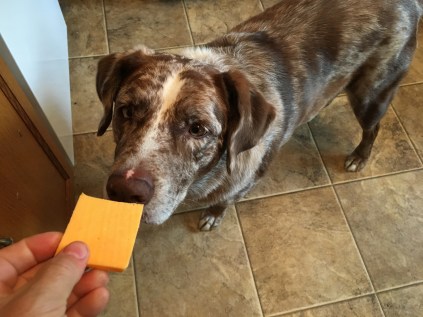
I Am The Cheese Dog

‘This is brand name organic right Karen?’

Sigh. Isn’t that the darndest thing? But I actually do find myself giving all sorts of recommendations on how to deliver medication to a pet. For many of my clients it’s fairly simple : they have a time tested treat that they can hide medication within and especially with the larger breeds of dogs and any garbage hound, down the hatch it goes. Medicine is a treat. For little dogs and those with pushed in faces and cats and birds and turtles and coyotes it can be surprisingly difficult to actually deliver the medication to its intended patient. Think about it. The brachycephalic breeds of dogs (Pugs, Bostons, Bulldogs) have all the body parts of a regular dog, just compressed into about 20% of the space. There’s no extra room in their mouth and they choke and turn blue if you try to get anything past them. Little dogs suffer from Napoleon Complex – they bite you if you try to force something on them. They know the Alligator Roll, too.


Cats? Hoo-boy, cats. We carry one medication for cats stocked in four forms: a tiny tablet, a chewable “gourmed” form, as a liquid and finally as a topical “transdermal” preparation. Yikes. Cat owners in particular are warned not to “dry pill” their cat, meaning do NOT shove a pill down your cat’s throat and forget about it. The pill or capsule may stick partway down, lodging in the folds of the esophagus. Without food or liquid to carry it down to the stomach, the medication may adhere and cause serious inflammation.  Most people have experienced the feeling at least once and don’t wish to repeat it. That’s why we swallow our meds with a glass of water. Esophagitis can affect a cats ability to swallow and in extreme cases lead to strictures or scar tissue in the esophagus. I often recommend that people be prepared to follow a pill with a syringe of warm water. This also helps cleanse the mouth of any aftertaste, making the experience more palatable (very helpful if you must repeat the medication in a few hours!). Feeding canned food afterwards is also effective. Many owners purchase special treats, some with a pocket to house the medication, to pill their pets.  Since medication in some form is almost inevitable for most dogs and cats, keep that in mind during training. Stay ahead of the game. And just to keep the record straight, the only cheese I eat out of a can these days has the word “Nacho” emblazoned across it. 


Christine B. McFadden, DVM

drmc@mcmenagerie.com 

Little Old Ladies

She was a little old lady, short and round as a dumpling. She energetically grabbed her dog from the exam table and tipped him onto his paws. You’d never have guessed her age except for the grey hair. Her dog found his footing and waited expectantly by her feet. “I’ve got to go”, she declared, “I have to decorate the Hall for my sister’s 50th wedding anniversary.” Wow, I marveled, that’s something! A blaze of blue eyes flashed at me. “It’s a pain in the-you-know-what” she said. “My 50th was 2 years ago and every day I wake up and wonder if we’re going to make it.”  She gave me a saucy grin and danced out the door, her dog following her in adoration. I stared after them open-mouthed. Awesome woman.

People and pets share their lives with me. It’s a jumble and a jungle out there, and hanging on to these moments builds a life. On a long work day, I spend more awake time with fellow staff than I do with my family. 

When I’d first started out in town I struggled to put my textbook medical knowledge together with my patient’s needs. My focus was on the animals and I learned their names first. This fact appalled me the day I rounded a clothing carousel at a local store and came face to face with a client. The woman looked up, a smile starting and then fading as I blurted out “Beau!” – not her name at all, but her dogs. Good grief! I worked harder to learn BOTH their names in future but don’t test me on that one. Over the years my brain often refuses to let go of the first impression, the pet we bonded over who is now deceased, so that I continue to call the next dog, or worse, the third or fourth pet that follows, by the original dog’s name. My staff cringes at these mistakes, occasionally alarmed as they search for other signs of dementia. There’s Zoie’s Mom. Oh, she has another dog now. Mrs. R is 87 years old. Last year she took a trip to China with her daughter. Next year they’re thinking of Australia. Zoie was a 10 pound black miniature poodle who had epilepsy and the sweetest disposition you could ask for. Her new dog is 3 years old, but she will always be the “new” dog. When we get together we talk more about Zoie. The new dog is very healthy and we don’t have twelve years of medical battles fought and won to look back upon with her. 

And I have fond memories of the family matriarch, in her 90’s, who put out condensed milk for her cats every day. They were all terribly obese. She confided to me once that if they turned up their nose at a can of food she’d just open another flavor. Sometimes, she said, there would be as many as 7 cans lined up along her porch. I marveled at the ability of our pets to train us. She took in many neighborhood strays and it pleased her to spoil them. She laughed at my dietary advice. Condensed milk had seen her into her 90’s and I wasn’t going to convince her otherwise.  She gave me a chocolate colored blanket she’d hand crocheted. I have it yet.

old ladydog-walking-4426782.jpg

It was a little old lady who taught me about the bluing older woman used to take the grey out of their hair and make it lustrous white. True, sometimes it turned their hair a delicate blue. This invaluable knowledge helped me make white poodles whiter. 

I’ll be a little old lady someday. I’ll hoard cats and keep too large of a dog and goodness knows what other kinds of critters. I plan to wear purple with a red hat and act up just like those women in the Red Hat Society, because I love the poem by Jenny Joseph. And to all the older women who have shared their pets and their lives with me, thank you for enriching my days and just for being you.


Christine B. McFadden, DVM

drmc@mcmenagerie.com
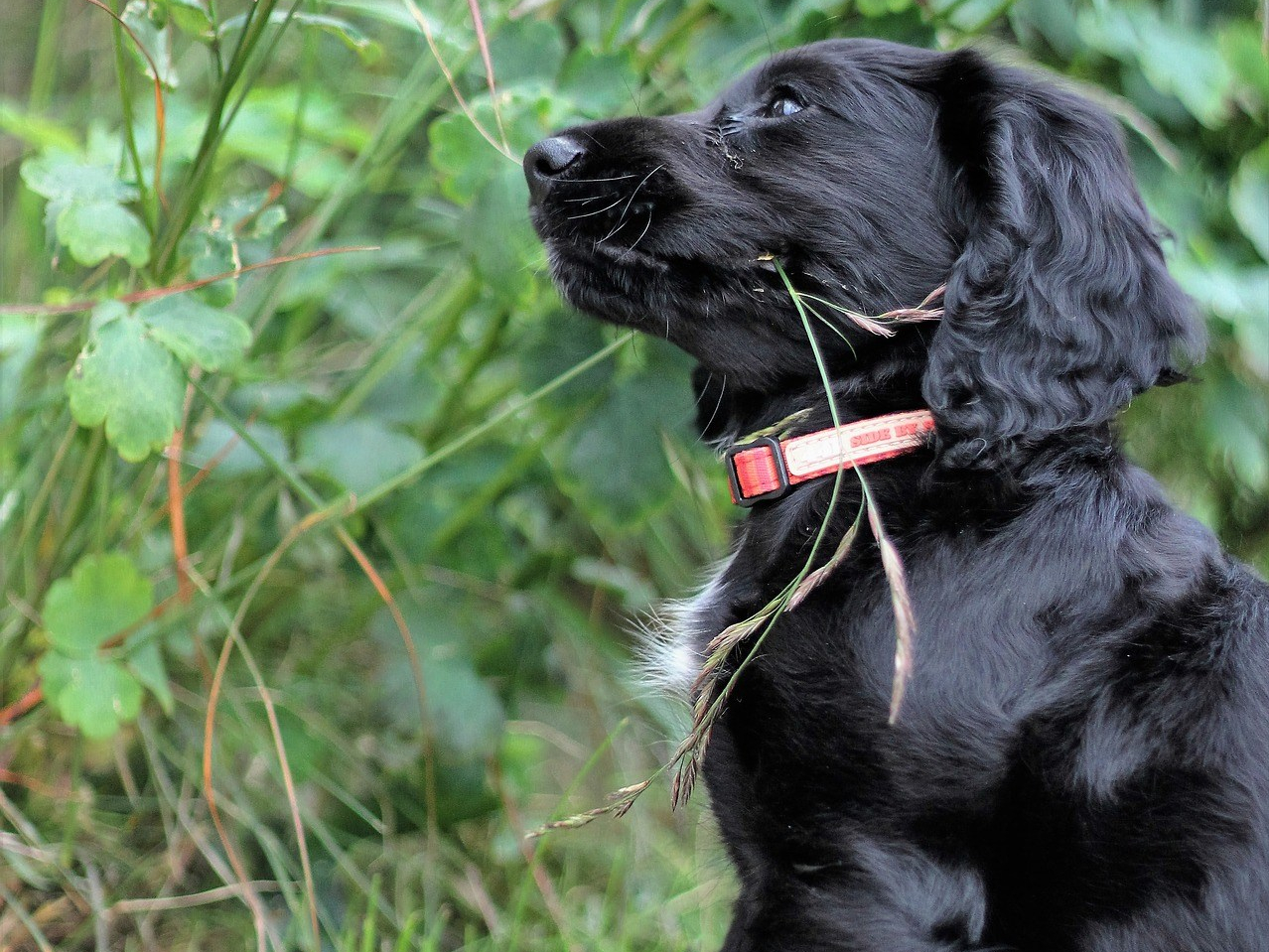
Molly and the Spider Plant

It was Molly who reminded me. Molly is an English Springer Spaniel. Her soft, silky black ears make it irresistible to gently pull them. Her owner was bewailing the fate of her garden, as young Molly had developed a fascination for a particular potted spider plant. She sought my advice.

MollyandtheSpiderPlant

My mind went drifting back to my third Irish Wolfhound, named Shredder. ( You can see photos of Shredder and I on my Facebook Page) If there can be karma in the name you give your dog then he was blessed with boatloads of karma. He lived up to his name. The glue on envelopes fascinated him, and given his size, no kitchen counter was safe for the deposition of mail. He took what he pleased and to this day I blame him for receiving a 5 day cut-off notice from the electricity people. He’s the only dog I’ve ever had who actually did eat the children’s homework. No one laughed. But the real pain in the neck was his attitude towards a tiny potted lemon tree I had started on the back patio. One morning, as I made my garden rounds, I noticed that the tree was a little crooked. Doubtless the dirt was settling, so I carefully righted it, tamping the soil down gently at the base. A few days later I noted it was tilted again. Puzzled, I again returned it to its proper position. As the days passed, I began to realize a pattern here, namely that the tree was being knocked sideways again and again. I was righting it on a daily basis! And then I caught him, Shredder, with a lemon leaf in his mouth, grinning happily, tail wagging. Such fun! Sigh.

So I moved the plant. Nope. Now, as a veterinarian, I had lots of training for behavioral problems. This was drummed into us students as very important, because poor animal behavior can lead straight to the Pound. I became annoyed. I staked the tree with a bamboo stake. Apparently this was not deemed fair play by the dog and next morning I found the tree completely sideways, a branch broken. I righted it. He knocked it sideways. Finally I took metal rebar, settled the tree more deeply in the pot, and firmly staked the trunk every few inches. Satisfied that I had prevailed, I went to bed.

The following morning the lemon tree was nowhere to be seen. When it was no longer fun, Shredder had simply removed the entire plant and shredded it. Who says dogs don’t have a sense of humor?

I did not share this story with Molly and her owner. I wanted them to have confidence in my advice. But when next I saw her, Molly had become truly devious. She not only enjoyed her spider plant but had branched out to include ALL the potted plants. I understood her owner’s angst. I wished I had a fabulous know-it-all answer. There are special Behaviorists in the field of veterinary medicine. They listen for hours to your problems and have reams of questionnaires to fill out. They have many inventive cures to modify and “cure” your dog of his or her behavioral problems. Most of them involve owner intensive time: “Take your dog for a 5 mile walk twice a day, he’ll be tired out and have less energy”(me, too); “Tell him no! sharply every time he goes near your plant, then distract him with a fun activity” (but I needed to run to the grocery store, I won’t be home to distract him); “Use the dimes or rocks-in-the–tin-can method” (but first, how do you really securely seal the thing and second, my aim REALLY is that poor – ouch!). Somehow, behaviorists always have the answers and most of it involves time that most of us don’t have – or the dog wouldn’t be doing it to begin with, right? Fence either your dog or your plants in (expensive! Not attractive!).

In the end, I wanted to tell her to dump the spider plants and try roses. It’s karma. You see, one of the meanings associated with the name “Molly” is “rebellion”. They should have looked it up first.

Christine B. McFadden, DVM

drmc@mcmenagerie.com
Connect with me on Facebook for shared photos and more!

The French Fry Challenge

Beware! Traveling veterinarians are everywhere!

Along with the vast hordes of people who undergo summer migration in odd patterns they refer to as “vacations,” we made our way across the North Pole to Europe, specifically France.

You may (or may not) recall that we had entertained an exchange student from that country earlier this year and that she had left us with the declaration (politely) that no where on Earth could the fabulous French Fry be found as it existed in her country, specifically the north of France.

The gauntlet had been thrown. Valiantly I threw all my free air miles into the purchase of plane tickets and we set off on our summer adventure. Our first venture with the French pommes frites (french fry) was …. drum roll, please : at an airport McDonald’s. Oooh la la!

Oddly enough, they tasted like a McDonald’s french fry here. Except they were accompanied by a lime green packet of “pommes-frites-sauce” which was a mysterious white color inside and tasted a bit like sweetened mayonnaise (if you’ve ever had sweetened mayonnaise?).

We passed. It must be an acquired taste, and in all fairness, we had to ask for ketchup everywhere we went, but they did have it.

I suspect when the shoe is on the other foot and the French are visiting us, we may not be so accommodating. We sampled the frites in Paris and across the south of France, then headed north to Lille, almost on the border with Belgium.

Here we met up with our exchange student, whose family welcomed us into their home. We sampled “les frites” in restaurants and roadside stands across Northern France and into Belgium. We ate them with dishes whose names we couldn’t pronounce and sometimes ingredients we couldn’t guess at.

We ate them wrapped in newspaper cones, served in clever tiny wire baskets and scattered across plates. Without exception they were served fresh from the fryer, hot enough to burn the skin off your fingers and tongue, and were indeed crispy/crunchy on the outside and soft and melting on the inside (or was that my tongue giving way?).

With a deep bow of respect, may I say that round one went to northern France in the “Pommes Frites Contestation.”

Wish this could become an annual event! We made the acquaintance of their cat, Plume, and several other pets along the way. We very much enjoyed our trip to another country and found ourselves, delightedly, also happy to come home.

There was much fun with “bonjour” and the French kiss, kiss greeting upon our return and then I got down to work. What a joy! I truly love my work and the people with whom I work.

In my absence, at the Applegate Zoo, our new Black-tailed Mule deer, Lily, had birthed twin fawns! Lily came to our Zoo only weeks before giving birth. She had been taken in by Fish and Game staff after reports of a deer coming up to people in traffic and trying to climb into their cars or mooch something to eat.

Obviously she had been hand-raised (surreptitiously, not legally) then released. Too imprinted on humans to live safely in the wild, Lily found a home here with us, where Donna, the head Zookeeper, watched over her vigilantly and assisted in the twins’ safe delivery on June 15.

Mule deer have a gestation period of about 200 days (compared with a human pregnancy of 280 days). Anxious that the mother and babies bond, Donna kept everyone away initially – not to worry, the little ones are as wild as the proverbial March hares! Right now they have their spots and are slightly smaller than the rooster they share a pen with. Both little does, the fawns will be able to stay with their mother at the Zoo.

Please come visit our City of Merced Applegate Zoo to welcome these newcomers and celebrate summer! A lively Special Celebration is offered this Sunday, July 22 from 10:30 a.m. to 1 p.m. at the Applegate Zoo. Meet the twins! A bounce house, water games, snow cones, popcorn and more will be offered.

Kids : Wear your swimsuits, shoes and shorts required! The zoo address is 1045 West 25th St. in Merced. Free parking.

Christine McFadden, DVM

The Water Cycle

Kids say the darndest things! This year “The Water Cycle” is being taught in Science at the high school, which came to my attention when a story was relayed to me the other night.

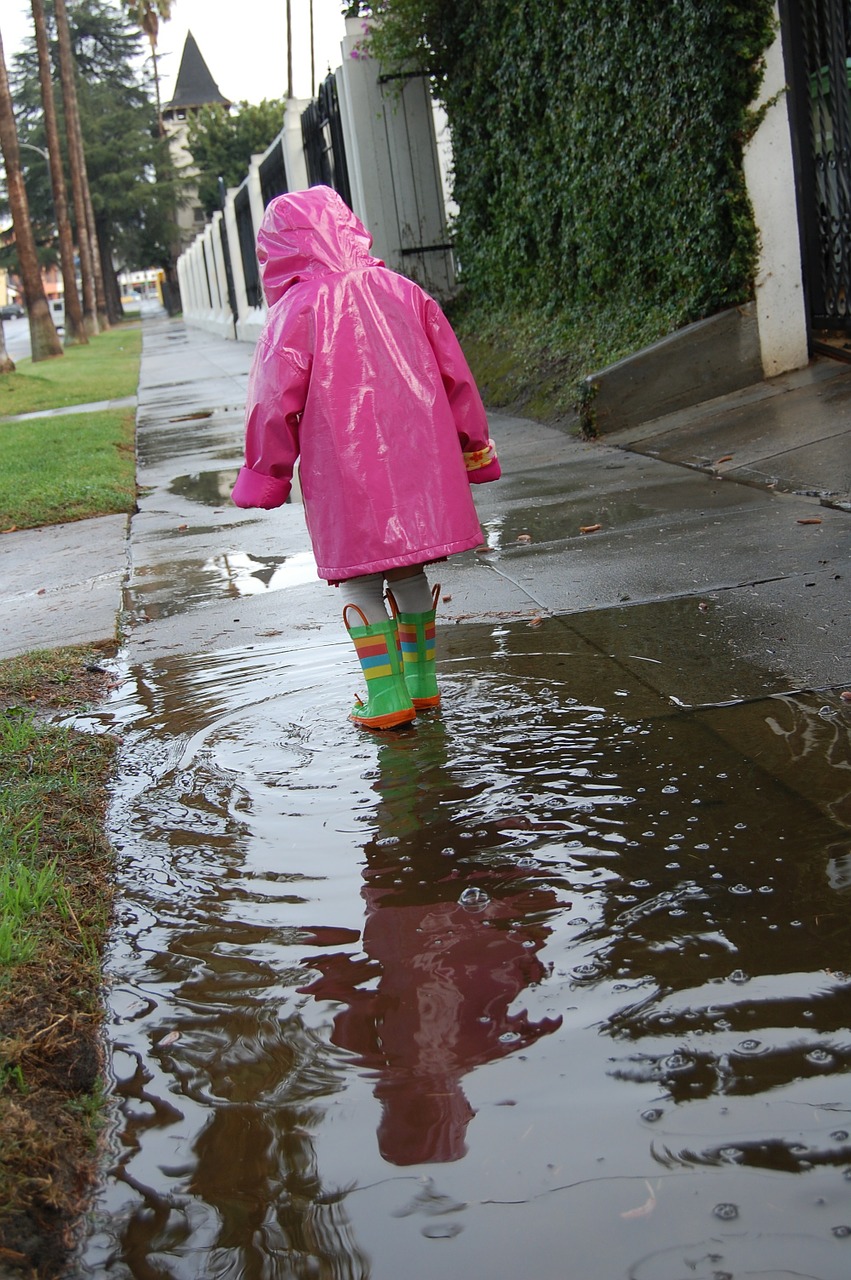
rainboots

It had been raining, and the young man was quite anxious. “It’s raining!” he exclaimed. “Yes, yes it is,” his teacher agreed. Drawing closer, he whispered, “Do I smell like pee?” Backing up, his teacher stared at him. “What are you talking about? Of course not!”

The student went on to explain his thought processes. He fully understood the Water Cycle and its importance to Earth’s replenishing and sustainability of its water sources. Taking it a step further, he reasoned that all the animals urinate outdoors – dogs, cats, horses and cows, bears and raccoons, all the wild birds, even the insects and fish. Well (his eyes widening), all that urine must leach into the soil and evaporate just like water! Which meant it was now returning to earth and raining urine on his head.

Having never thought this through to this degree I stopped to ponder these ideas, searching for merit. His teacher, I might add, did no such thing. She told him the clouds filtered out impurities and the rain was clean and he could retake his seat. He was most relieved. I was impressed at her quick-witted response. This is where the scientist in me gets bogged down. This is why I’d be a lousy teacher.

So, the Water Cycle, in its simplest form, explains how water covers 71 percent of the Earth’s surface. This water cycles through several steps: It evaporates into the atmosphere, where it condenses into droplets that form clouds and later falls back to the earth as precipitation (rain, snow, hail, sleet), which is collected or returned to our oceans, lakes and land.

Next, urine from mammals is composed of about 95-percent water plus some other compounds, including urea. Urea contains nitrogen. This fact is very important to a different science lesson, the Nitrogen Cycle. Nitrogen is necessary for all life as the building block of protein, which both plants and animals need to grow. Nitrogen is the most important nutrient that plants get from the soil. The soil receives this nitrogen in two ways – nitrates come from animal solid waste like manure. From liquid waste like urine comes urea. Another way nitrogen is acquired is through decomposing into the soil.

Birds and reptiles are uricotelic (I wrote this whole story so I could prove I know that word), meaning their urine waste is in the more solid form of urates (that white stuff in the bird’s droppings) than liquid urine. It’s simply how their non-mammalian rudimentary kidneys function.

This is a very long-winded way of explaining that only the water from body wastes can evaporate into the air. All the “impurities” or other compounds are left behind to enrich our soil. Rainwater is essentially distilled water, free from impurities unless it picks up local air pollution/ dust or other debris as it returns as precipitation during the Water Cycle.

This is the most amazing win-win ever! So put on your galoshes and go splash in some puddles!

And have a great day!

Christine McFadden, DVM

Send questions or comments to drmc@mcmenagerie.com.