Ronda and the Very Bad Paw

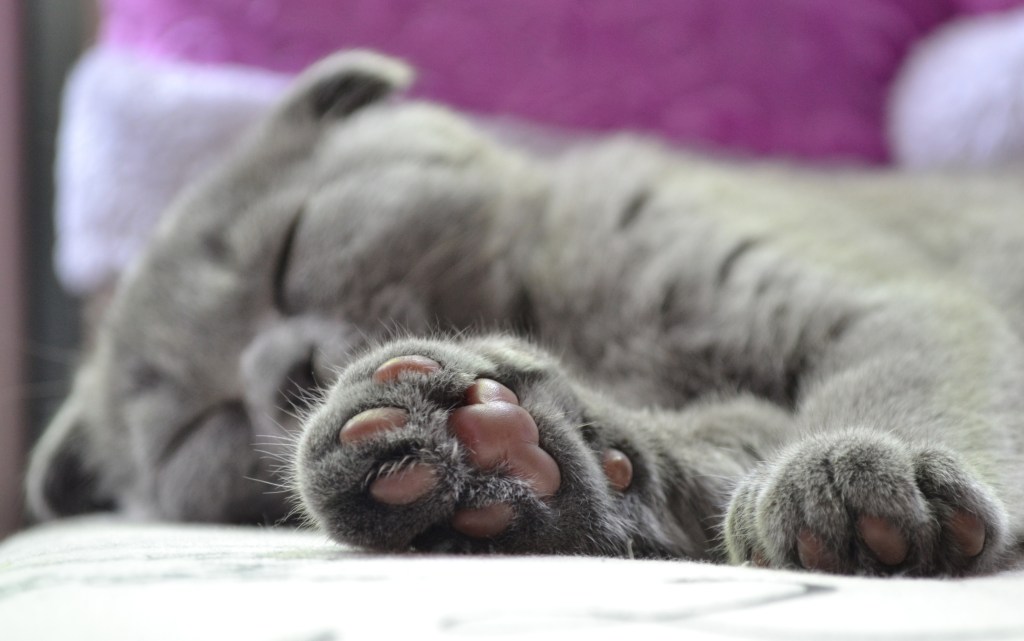
It was late in the day when the Animal Control Officer from the City of Merced Police Department brought us a stray cat that was in trouble. This service is provided to injured stray animals in the City, and it is up to us to determine if they can be helped or, sometimes, to help end their suffering. This little grey cat weighed in at 7 pounds and had a left front paw mildly swollen from what appeared to be a bite wound. She was running a fever, almost 104 degrees F, but was purring and in general seemed very happy to have been found. We shaved her wound; the paw didn’t look too bad. We could help her.

Under anesthesia I opened the abscess so that the pus could drain out, using a sterilized rubber band to act as a seton or drain to keep the tiny wound open for healing; otherwise it might close up too quickly, sealing bacteria inside and the abscess would not resolve. The cat was temporarily named “Ronda” by the staff, given an antibiotic injection and some subcutaneous fluids for her fever and placed in a cage with her own comfy blanket.
End of story, yes? I moved on to other patients, leaving the daily nursing to our extremely capable nursing staff. When no one claimed Ronda after several days, we approached the local Rescue Group, New Beginnings For Merced County Animals, to ask if they might be able to find a home for her. They agreed to take her in. New Beginnings was founded over 11 years ago by a remarkable local woman, Sharon Lohman. The non-profit organization works with over 70 volunteers and pet Foster parents to find homes and care for well over 5,000 dogs and cats each year. It is estimated that they have saved the lives of up to 75% of the dogs who enter our local shelters.

Well, Ronda’s story didn’t end with that first minor surgery. Her swollen paw didn’t respond to treatment. Irritating. Abscesses like this just aren’t that medically challenging. I threw a second, high powered antibiotic at her, and added twice daily foot soaks in antibacterial wash. Kindergarten medicine! Open an abscess up, drain it, and voila, they practically heal themselves! Ronda, however, hadn’t read that medical bulletin. Pus was leaking around the drain, but her paw wasn’t healing. We tested her for the feline leukemia/FELV and feline aids/ FIV viruses, in case Ronda was immunosuppressed. She tested negative for both (and people CANNOT get HIV or AIDs from cats).

Eight days after she had been admitted, Ronda was still there, her paw enormous! We took x-rays, looking for signs of abnormal bone tissue, maybe a sliver of metal acting as a foreign object. Zilch. Normal. I was worried that Rescue wouldn’t take her. (They do a lot of fundraisers, but sometimes it comes down to “do you want THIS animal, or will helping 5 others be better?”). Now we were discussing amputating her front leg to save her life. I was furious with that paw. Because of the progression, I was certain that I was dealing with an anaerobic bacteria, one that didn’t require oxygen to grow. These bacteria can be difficult to kill. I asked for the weekend, and told Ronda she had one last chance.

I took her to surgery again. Knowing that I had to expose all possible tissue to oxygen, leaving no place for bacteria to hide, I literally dug through each toe, around each pad. I placed two ¼ inch penrose drains (don’t ask me how) in that tiny paw. I added on an antibiotic better known for fighting anaerobic infections and we all sat back and held our breath. In 48 hours her paw was fine. Ronda kept her leg, healed quickly from that point on and went to her new home. Lesson re-learned: Never assume.

Christine B. McFadden, DVM

drmc@mcmenagerie.com

Follow drmcsveterinarytales on Facebook for even more!

Missy and Hypoglycemia

She was so small that her big sister was a Beanie Baby. She’d been sold straight from a cardboard box in the parking lot of a Big Box store. Her owners were entranced from the moment her fluffy 1 ½ pound body hit their hands. The sellers were short on details like birthdates. We guessed her to be 2 months old? She was christened Missy, her basic exam checked out, and she had her first vaccination before they took her home.

The roller coaster ride had begun. Sadly, Missy had already been exposed to Parvo virus. Parvo is dreaded throughout our Valley, as we seem to see a lot of this viral disease in young, usually unvaccinated dogs. With no immunity, they fall ill, exhibiting extreme vomiting and a watery bloody diarrhea. The virus further attacks their body by dropping their white cell count, so they can’t fight off the infection. Many puppies die from the disease. Supportive therapy in-hospital with intravenous fluids and medication provide life support while their body recovers. It’s a puppy’s best chance to survive. Missy was sick so quickly we knew that she had been incubating the disease when she was brought in and the vaccine wouldn’t have had time to provide protection. (The vaccine itself does not cause the disease) Further complicating matters was her very small size. She had no body fat to speak of. Placing an intravenous catheter in her threadlike leg vein was a miracle. And like many tiny, tiny puppies she couldn’t keep her blood sugar up without constant eating – and Missy couldn’t keep anything down. If her blood glucose levels plummeted she might faint, seizure or even die. To counteract this, we added dextrose to her IV fluid drip. And then we worried about overloading her tiny body with fluids or we might flood her heart! We have an IV syringe pump that carefully meters each drop to these most extremely small of all patients.

Missy was a fighter. She gamely held on and after four days Missy turned around and successfully fought off parvo. Hurrah! But within days it became obvious that Missy’s body couldn’t regulate her blood sugar levels on it’s own. She would appear dazed and weak at home for no obvious reason. I had to explain that Missy couldn’t waste a mouthful on treats – many treats are high in sugar (check the labels for corn syrup, dextrose, sugar beets, etc) and just as with diabetics, it gives a quick sugar high and then just as quickly dips back down. The dangerous Sugar Rollercoaster. Don’t take that ride! Missy needed to eat dog food, with protein, fat, slow-release complex carbohydrates (carbs are the sugars in food) and the calcium, vitamins and minerals a growing puppy needs. For several days she had to be fed every two hours, including at least once during the night. We expected her to outgrow this…. but when?

Missy’s body did learn to self-regulate. She grew to over 4 pounds. She finished her series of puppy shots and had no further health set-backs. We set the date for her ovariohysterectomy /spay for 8 months of age, when I could reevaluate her teeth – tiny dogs often have delayed dental eruption (they are slow to lose their baby teeth) and if retained, the baby teeth will crowd the adult teeth, trapping food particles and eventually rot out both teeth! It is so much easier on the puppy to remove these excess baby teeth under the same anesthesia they undergo for their spay / neuter surgery. We schedule the surgery when the adult teeth have come in. The big day came. We checked Missy’s blood sugar before surgery. Normal. We checked her teeth – she had retained three deciduous canine (fang) teeth. We extracted them. Hurrah!

Monitors beeping calmly, we proceeded to spay Missy. She acted like a completely normal patient, recovering beautifully. Hurrah! Postoperative blood glucose tests were all normal. Another hurrah! I don’t know if her little feet ever touch the ground (spoiled by love), but in addition to all the other miracles, Missy is a superb outgoing doggie friend to everyone she meets. Hurrah!


Christine B. McFadden, DVM
drmc@mcmenagerie.com

Hysterical Clients

Who said veterinary medicine wasn’t fun?

There’s the man who got out of jail (he didn’t say why- either for going in or getting out) and came home to find his dog sick. This enraged him. We know this because he brought the dog to us (he was passing by, thought he’d drop in) and he was very thorough in his explanations to us of society’s injustices, particularly that he might have to take financial responsibility for his pet. We couldn’t diagnose the illness without a blood test – and magic wands are out of date, though I kept one on my desk for years. We’ve kept statues of the Virgin Mary, Buddha, dice, and a crystal ball. We do not turn our nose up at anything that might intervene on behalf of our patients. In the science-based world of medicine we have seen miracles – but we have also seen cases where the pet should have lived, by all rights, but died. In the end, we fall back upon diagnostic tests because they do just that: they help us to diagnose your pet’s illness, to unlock the pieces of the medical mystery so that we may help the patient.


This man was very angry. The time spent in jail seemed not to have been used for self-reflection or internal contemplation. It seemed unlikely that he read poetry. We thought we should focus on the dog. We weren’t entirely sure he could focus well enough to drive. He had no interest in paying to care for his dog nor did he wish to surrender it to a Rescue group. So he left. Only to return a half hour later, which we noticed immediately because his car was sideswiped as he drove in to the parking lot. While he was waiting for the police to show up (to investigate the accident) he surrendered the dog to Rescue. Post-script : dog did great.

And I fondly recall Crack-A-Nose. Her name alone kinda gives you a heads-up, yes? A pitbull, she had a huge pink mass of doughnut-shaped tissue protruding from her vulva. Bigger than your fist. It was very dramatic. This dog had a condition called vaginal hyperplasia, or swollen vaginal tissue. It is not a true prolapse of the vagina nor a cancerous tumor. It occurs when a female dog has been in heat, producing high amounts of estrogen. The swollen tissue will shrink back to normal size when the estrogen hormone has declined – and the fastest, most effective and permanent cure for that is to recommend an ovariohysterectomy or spay. I explained all of this to her owner, a young woman who was rail thin with blond hair, beautiful, a little twitchy. The young woman pulled a fistful of hundred dollar bills out of her bag. She requested that I perform whatever services were required and informed me that she would pay in full right then. I agreed to her terms and performed surgery successfully that night. I figure the dog must’ve been a great guard dog for some very important stash, oops, stuff.

Now stop me if I’ve told you this one before. This was when I worked in a small office off Highway 59, still called “J” street back then. I remember the skirt I was wearing because it was the last time I’d ever wear it. It was quiet, around lunchtime. A man in his twenties came in. He announced that his dog had been run over by a mower. I was nearby and nodded, told him to bring the dog in. Occasionally you see an overactive puppy bouncing around a lawn mower and accidentally getting a toe clipped. Not very serious. He stared at me. But he’s bleeding, he said. I nodded again. This was to be expected. Please bring him in.

And he did. Only he hadn’t been talking about some little push mower, he meant a tractor hay/disc mower (the tractor weighs over a half ton) and it had practically amputated the dogs’ leg, so the “bleeding” he’d mentioned was an enormous spraying jet of blood from the severed femoral artery. The dog was going to bleed out – I was surprised it hadn’t died already. I stepped in with a pair of hemostats to stop the gushing fountain and got lucky. I completed the amputation in a sterile surgery and the dog lived. But my clothes were history.

Christine B. McFadden, DVM

drmc@mcmenagerie.com

My Husband’s Hospital Vacation

My first indication that text messaging had gone too far in my household was the afternoon I checked my phone and discovered the following message : “Just wanted to let you know. I thought I might be having a heart attack so I checked myself into the hospital.” It had been sent from my husband’s cell phone.


What you need to know were the events preceding this text message. My husband had taken our children skiing two days earlier. On this morning, he had done some moaning and groaning around the house. The problem is, I not only have to get ready for work myself, but I oversee care of the kids, the cats and the chickens before leaving. Getting to school on time is a mountain we climb every day. If it’s not worth opening your mouth to speak up about something, I’m not going to slow down long enough to start an inquiry. He knows where to find his Advil.


I confess I felt more irritation than anxiety when I read the message. Really? I’d had a full day and no lunch up to that point. So I called him. He answered. He sounded cheerful. Enough hours had passed before I’d discovered his message that he could assure me that his chest x-rays, his blood tests and his EKG were all normal and he wasn’t having a heart attack. So why are you still there? I reasoned. Well, he rambled on, this doesn’t explain the pain. “What about arthritis?” I asked. Oh no, he assured me, I’ve never had arthritis here. It’s on my right side. I was driving myself to the golf course and felt pain in my right arm, so I pulled over and googled heart attacks. It said they would be on the left side, but I thought I should be sure. They’re going to run another test to see if I have blood clots. If it’s abnormal, I’ll stay for a CT scan.


OK, honey. I returned to my own patients. There was a cat that had been tumbled in the dryer for 7 minutes. She appeared dazed, with tiny bruises starting to appear on her skin where patches of fur were missing. She was a lucky cat; only last month, another cat had actually died in a similar accident. We began treatment for shock and started the cat on IV fluids.


It was closing time when my husband called. My test is abnormal, he said. “What’s the name of that test, hon?” D-Dimer. We use the D-dimer test in veterinary medicine. Platelets, the cells that help blood coagulate or clot so you don’t bleed out, will slowly break down after they’ve served their purpose. If your body is forming big blood clots where it shouldn’t, the by-product of platelet breakdown will be very high in the blood stream. The D-dimer test measures this level.


For a variety of reasons, I didn’t believe it. So while getting the kids squared away I researched the normal blood levels for humans. Armed with this info, I went down to visit my husband in the ER. He looked remarkably fit. In fact, he wasn’t feeling any pain, though he’d not been given any medication. I asked his nurse for the actual number on his D-dimer test. It was less than 200. I stared at the nurse. “But that’s normal”. Yes, the nurse agreed. I stared at my husband. “Who told you it was abnormal?” He frowned, concentrating. He wasn’t sure (What else did he have to do?). About then they came to wheel him down for his CT scan. They said it would be read that night. Forgive me my skepticism, but having assured myself that my husband was doing very well, I kissed him and told him to enjoy his scan. At this point I reflected that if they did find something wrong with him, it would not be what he’d gone in for. I slept poorly (despite my brave front). At 2:20 in the morning (5 hours later) my husband sent a text message that he had completed his CT scan but it wouldn’t be read until the next day.


I visited him on my way to work the next morning. He was cheerful and even complimentary on the hospital breakfast. They were going to run some more blood tests. I left him to it.


At work, my own patients were well. My dryer tumbled cat looked much better and was enjoying a hearty breakfast herself. Her bloodwork was excellent. By early afternoon I was discharging my patient to her ecstatic owner. Back at the human hospital, my husband had been leaked the information that he had a “non-displaced hairline fracture in his right rib”. My husband was now being offered an echocardiogram and had begun to call me every hour or so. I told him if he couldn’t relieve the babysitter by 3:30 to let me know. If he wanted to stay another night in the hospital that was on him. I was worn out.


Once he knew it was just a cracked rib, my husband felt lots better. I arrived home that night to find he had invited several people to dinner and cooked up a storm. Even better, he could go on his golf vacation next week.


I am SO grateful my patients can’t talk!


Christine B. McFadden, DVM

drmc@mcmenagerie.com

Taking in an Exchange Student

It started with a phone call. Would we consider taking in an exchange student for 10 days? She came from France and would spend most of her days joining the rest of her group in planned activities. We were expected to feed her breakfast, dinner if she was there, and provide her her own bed. We figured we could do anything for 10 days. Not to mention I would love to visit France. We said “yes.” We were able to review letters written by several students to their prospective host families. I studied them carefully and narrowed our choices between two. My girls paid no attention to my detail and chose the girl with the same name as theirs.

Drumming up my best high school French, I wrote to the family. I received a telephone text message from our student through the internet app “WhatsApp?” She sounded nice. We made a welcome sign for her and sent her a picture of the sign so she could find us (just in case she forgot her name?). When she got off the bus she had been traveling for 24 hours. Unlike online dating sites, she looked just like her picture. We brought her home, my twins chattering happily away to her, while I interjected an occasional explanation in French and my husband just drove. I bet she had a headache.

We fed her dinner and sent her to bed. She closed the door on us all as she prepared to sleep and three cats started to yowl outside it, beyond curious at this new visitor in the house. Desperately I flapped kitchen towels at them to shoo them away without disturbing her. The next morning our first pictures were of her trying to unpack her suitcase as the cats prowled through all her belongings. They seemed to find French jeans exotic and believed she had traveled all this way specifically to meet and pet them.

She had a cat at home and was kind to ours. She was out of the house for most of the day and fell asleep on the couch at 8 p.m. each night, which was about 4 in the morning for her at home. Overall I was impressed with her adaptability to a somewhat grueling schedule. She fought jet lag far better than I.

I purchased croissants and French cornichon pickles for her. She ignored them. Ooh la la, what was this? She didn’t drink coffee or wear red lipstick. She didn’t come from Paris. She was a real girl, kinda just like us. Quel surprise!

I made sure she visited a Starbucks and my husband treated her to an American Hamburger. After eating the hamburger with knife and fork she pronounced it quite good – but the French fries, well, her part of Northern France makes the best French fries in the world! This outlandish statement assured my husband’s commitment to travel to her hometown in Northeastern France. He will follow his stomach anywhere.

I invited her and a friend to the veterinary clinic one morning when their schedule was open. She saw some surgery and took a photo with a monkey from the Zoo. They watched some dentistry and left before I could get into some really interesting bowel surgery. They didn’t seem sad to miss it! I’m pretty sure that I convinced her to continue with her current studies, which did not include the pursuit of veterinary medicine. We posed for pictures in front of the clinic sign to remember this moment, like the Treaty of Versailles.

When she returned home, her cat sent a picture to our cats. I’m still waiting to see if their veterinarian will offer me a job. I can say “heart” and “knee” and “medication” in French – surely on the strength of that I should be hired? As a last resort, I can always fall back on the allure of French fries – my husband will take me there. Vive les frites!

Christine McFadden, DVM

drmc@mcmenagerie.com

The Parrot Who Ate Caramel Corn / Heart Failure

Unbelievable. If I dared roll my eyes during an interaction with a client, my eyes should have been doing cartwheels during the intake history I was noting on the chart.

My patient, an African Grey Parrot named Joe, was lying face down in his carrier, his beautiful red tail inelegantly dragging in the muck and mire. I was afraid to handle him, for fear it would push him over the brink. As I stalled for time I observed him from a safe distance, thoughts milling through my head. It creates a poor first impression when you touch your patient and he falls over dead.

tequilapalomitas.jpg

The question I’d just asked was about his preferred foods. I was secretly hoping to hear that he ate a sunflower seed only diet, because this is the pinnacle of poor nutrition for the average parrot and was quite popular 30 years ago when most birds were imported and went through the rigors of quarantine stations before finding their way into homes. Thousands of parrots seemed to subsist on sunflower seed alone, whose nutritional value, though high in protein and fats, was loathsomely deficient in calcium and other life-sustaining vitamins and nutrients. 

The secret card up my sleeve? African Grey parrots, both the Congo species and their smaller cousins the Tymneh, were unusually susceptible to severe sickness from hypocalcemia. In addition to building strong bones, calcium is needed for all muscle contractions, including the heart muscle, and low calcium led to seizures or tetany and cardiac arrest. The treatment was simply supplying calcium and a little vitamin D to the afflicted parrot and most would turn around. The stuff of miracles and who doesn’t want to see a miracle?

But this woman! What was she saying? Forget seeds. Her bird subsisted on caramel corn? Peanut M&M’s? Pizza? Impossible that this bird could survive the high salts and fats and sugars of this diet! Let alone live to 42 years of age. But here he was. Although, as I knelt to get a closer view, one could not say that he was “living.” Not yet dead was more accurate. Gingerly I opened the cage door and slowly pulled him out. Joe didn’t move. I finally placed my stethoscope to his chest without disturbing his position on the towel. Oh dear. He had a heart murmur and his heart was beating very erratically. Cardiac arrhythmia. His abdomen bulged ominously. A tumor? The case was hopeless. The bird had never been to a veterinarian before and this was clearly too little, too late.

Which I tried to explain to his owner. We could do diagnostic tests, but he might die while we were trying to help him. The tests would be expensive and some would take a day or more to get results. I didn’t think he’d live long enough to find out what was killing him, let alone help him. I hate cases like this.

Joe’s owner requested that we proceed.

We placed him in an oxygen cage. Then, using gas anesthesia, we let him breathe himself into a state of non-painful peace and took x-rays, drew blood, obtained culture samples and tapped his abdomen (abdomenocentesis). No tumor. Joe appeared to be in congestive heart failure. What’s more, he woke up. I had given him several medications while he was still out and he remained on supplemental oxygen. Fast forward 24 hours. Joe is standing, a little wobbly, and has lost 50 grams of retained fluid overnight (10 percent of his entry weight). His blood calcium test is normal. Too weak to eat well on his own, we gavage fed him, using a tube to place baby mush directly into his crop. Fast forward 72 hours. Joe is talking, grooming himself and cracking seed. We take him off oxygen. On Day Five I sit down with his owner and explain that against all odds, her bird is adjusting well to oral medication and can go home. He will need medication the rest of his life. Given the seriousness of his condition, I tell her each day is a blessing. This is good enough for Joe and his owner.

We stayed in touch. Joe continued to improve. On Day 10 his owner happily reported that Joe was eating caramel corn again. Tongue-tied, I pulled back and stared at the phone. Not the goal I had in mind. I kept quiet. It’s been more than one month since I first met Joe. He is doing very well on his heart medications. I may start eating caramel corn myself.

Christine McFadden, DVM

Send questions or comments to drmc@mcmenagerie.com

Have A Nice Day !

George Carlin, a comedian I’m not much familiar with, found fault with the phrase “Have a nice day,” saying it was “probably unrealistic to expect someone to have a nice day all day long.”

I am as guilty as the next person at wishing people I meet to “have a nice day” upon taking their leave. It has become an ingrained auto-response. The phrase is depersonalized and meaningless more often than not. Carlin’s riposte struck home because it has only been a few weeks since that very phrase landed me in the middle of a hostile exchange between my staff and a client.

The first I knew that we had a problem was finding a chart on my desk with a note “Client upset. Please call.” We get very few complaints, surprising, perhaps, given the number of animal patients we see in a day and the variety of human clients attached to them. I suppose some people never discuss their dissatisfaction with us and simply go elsewhere with their pets. Our best clients tell us when we have let them down and I very much appreciate that – how else to improve our services? And then there are, well, those days that we just mess up. We don’t just drop the ball, we kick it over the fence. No half measures for us, no sir.

So I read the chart. It landed on my desk because I had examined a cute little Maltese dog and vaccinated her when she first arrived to board with us. That had been days earlier and I had not heard of any problems during her stay. I then requested to speak with any personnel who might be able to enlighten me. This can be a dicey tightrope – understandably your staff wants to feel that you’ve got their back and truthfully, the client is not always right.

With half the story under my belt, I felt prepared to call the client, who was pleasantly surprised that I even called. The saga was not life threatening in any way but was important. The client had requested her dog be bathed upon arriving at the clinic. This made no sense to the staff because like some people, a dog away from home may exhibit different behaviors than their owner is accustomed to. He may stay up until all hours of the night. She may bark joyfully nonstop. Both will engage in food fights, scattering food willy nilly. Someone peed on their favorite blanket then ate it. In short, your calm little house pet may have the manners of the worst frat boy party animal you’ve ever seen depicted in a movie once you step away. I know, I’ve seen ‘em. So we always suggest a bath and fluff up right before heading home. Time to put the leash back on. Momma’s coming and you don’t want to disappoint Momma.

In this case, the staff just thought someone heard it wrong, so they waited to give the bath 4 days later, when the dog was scheduled to go home. Only Momma came back a day early. We absolutely would have given the bath then but everything got bolloxed up in the explanations and finally the good woman took her dog (bathless) and went home. The final insult? As she was leaving in high dudgeon, one of my staff called out “Have A Nice Day.”

Ouch! Hit that ball right out of the park.

I was treated to a delightful lunch at a Ruth Chris Steakhouse recently and noted that at every request the staff responded “with pleasure.” I considered trying to incorporate this into my daily interactions with clientele, but somehow, when asked to express anal glands I think saying “with pleasure” could backfire on me. I am trying to rid myself of “Have a Nice Day.”.

Christine McFadden, DVM

drmc@mcmenagerie.com

Reflections Back on 2017 from the New Year

I can’t speak for you, but let me start this by saying that I spent my first night of the new year sleeping on the floor. No, you too? So let our first resolution be to stay home next year! Nothing stronger than water had crossed my lips, we missed the ball drop in New York because we were arguing too much as we channel-surfed at the last minute and I couldn’t tell you if there were midnight fireworks because we were all asleep long before the year crossed over. Some of us on the floor. I was there mostly because the makeshift mattress set up for the kids was very narrow. If you were next to your mom you would be snuggling, but if forced to share the same space with your sister it would have been a war zone all night. I chose “some sleep” over “none”. The great thing to come out of this? Everything settled to the down side and I’m convinced my silhouette, as seen from the left, is much slimmer.

I had lots of time to think while performing this balancing act. I remembered the faces of some I’d said goodbye to in the previous year. “Nella” was a gallant Golden Retriever. He was named as a young dog by a child too young to know a girl name from a boys and owned by a war veteran too kind to correct the child. Nella was the color of a vanilla wafer cookie. He was a big-hearted dog, always gently greeting me with a wave of his plumed tail, no matter the exams, the blood tests or x-rays that were needed. At 16 years of age, he suffered from severe arthritis. His owner always had a kind smile and a silly joke when he came in. He thanked us for our efforts to keep the big dog comfortable. He cooked for Nella when needed. On the bad days we hugged. And finally there was no denying that the most loving thing he could do for his dog was to let him go.

I started 2017 with a C-section delivery on Jan. 1. Ring in the new!

I ended 2017 with an 18 pound cat, Shrek, that had his bladder obstructed by tiny bladder stones they call “sand.” He couldn’t urinate. His bladder filled up tight as an over-filled balloon and the plumbing backed up until the pressure shut down his kidneys. It is hard to walk when your bladder feels like a large boulder in your stomach. When your kidneys shut down you feel tremendous nausea. It’s called uremic poisoning, because the body waste that the kidneys should filter out are reabsorbed into the bloodstream, poisoning you. It is impossible to eat when your kidneys shut down. A true emergency, his bladder at risk of rupture, we rushed Shrek into surgery. Under anesthesia we spent long minutes trying to break down the plug of small grit blocking his urethra until we could place a bladder catheter and empty his bladder. Then we pumped him full of intravenous fluids to encourage his kidneys to go back to work. Shrek looked a little odd, with one tube dripping fluids in at the front end and another dripping out more fluids (urine) at the back end. Key to prevent recurrent formation of this “sand” in Shrek will be his conversion to a diet of food developed specifically to prevent urinary sand of Feline Lower Urinary Tract Disease (FLUTD) syndrome.

My final thoughts before drifting off to sleep were of the first stanza of a poem I memorized years ago. The poem is by Alfred, Lord Tennyson.

Ring out, wild bells, to the wild sky,

The flying cloud, the frosty light:

The year is dying in the night;

Ring out, wild bells, and let him die.


May the new year be kind to you and your pets.

Christine B. McFadden, DVM

drmc@mcmenagerie.com

The Large Animal Vet


Perhaps the title sounds misleading. A “large animal” vet develops a veterinary practice caring for the needs of livestock such as cattle (dairy or beef), sheep, goats and pigs. A “small animal” veterinarian like me is usually slotted into the care of companion pets such as dogs and cats. So when I examine a 200 pound dog, it is still a small animal and likewise there is often confusion about whom to call when the patient is a pot-belly/miniature pig. Not me.


The life of a small animal vet and that of a large animal practitioner are markedly different. One works almost exclusively indoors, dressed neatly, white coat in place. The other weathers life outdoors, facing extremes of blazing heat to icy cold, rain and snow. One always has a sink handy to tidy up. The other uses outdoor hoses more than they’d like. A dairy vet may check over 100 head of cattle in a morning and four “farm calls” make a full day. A small animal vet may follow the medical strands of more than 25 patients a day, winding through exams, blood results, x-rays and working in a surgery or two.  All juggle the demands of unexpected emergency work.


Being in an office most of the day, I rarely interact with my brother and sister large animal veterinarians. So when the pygmy goat from the petting zoo fell over dead I was unhappy, but proceeded to perform a post-mortem examination and sent tissue samples off to our regular lab. I had overseen the care of these goats for many years, but they were on the back burner when it came to my interest in the truly exotic Zoo collection. My concerns centered on whether or not the public might have fed something odd to the goat? (I’ll jump ahead here : No. The public did not harm the goat). I mulled over the problem but prepared to wait until the pathology report was finished sometime in the next week. And then another goat died.


I was unnerved. The goats were being closely watched and none had shown any outward signs of sickness. They had all lived for more than 8 years at the Zoo and had never, collectively, suffered a single injury amongst themselves. I immediately sought the expertise of a Large Animal veterinarian. The Goat Expert was on a dairy farm. The return call came in as I was finishing one surgery and about to start another. Gloves still on, I was staring at some x-rays

in-between these surgeries when they told me they had Dr. B on the line. Multi-tasking at its best.


I hurried over, snapping gloves into the waste receptacle and grabbing pen and paper. I introduced myself and LAUNCHED into a recital of my goat woes. I verified that he had goat experience? Yes. I gave him dates, genders, date of deaths, lack of lab results, still pending. I drew breath to spew forth another list of details and heard him gently respond, “Yes…. I think…. I might be able…. to help”. His measured tones were from a man used to the gentle rhythms of milking machines, contented cows swishing their tails, chewing their cuds. Da-dum da-dum to my staccato dop-dop-dop-dop-dop! I managed to squeeze in a few more hurried sentences (surgery! Waiting!) before he responded calmly, “I think I drive past your practice on my way up from this dairy….”. I opened my mouth. Closed my mouth. I could hear the clouds, feel the sunshine, almost see the shining black and white hides of the gentle Holsteins he surveyed as we spoke. It was all there in the rhythm of his speech. I told myself to stop yapping before he decided my goat problem would be too stressful for him to bother with.


An hour later Dr. Thomas Bauman drove up in a large truck outfitted for all manner of veterinary ministrations. He spent an hour and a half doing a post-mortem on one goat. He had a wicked knife and mulled over the cause of sand in the stomach. He felt it was too much. Did we feed on the ground? No. But little kids feed the Zoo goats oat hay pellets and they often dropped to the sand, with all the goats scrambling to get their share. Hmmm. He gave the problem his full attention and we submitted a gazillion samples to the State Lab, including an intact eyeball because it would be useful for trace metal analyses. The final answer was a copper deficiency in the feed, to which Pygmy goats are especially susceptible. Hay grown in the San Joaquin Valley is often deficient in copper. The salt lick fed at the Zoo did not have added copper because Alpacas are in with the goats and they are susceptible to copper toxicity (too much) if supplemented. So we now feed our goats little capsules of copper wire every six months and all is good. But sometimes I find myself wishing that I was a Large Animal veterinarian. Just so I could slow down and smell the …..never mind.


Christine B. McFadden, DVM

drmc@mcmenagerie.com

Are We Communicating, Doctor?

National Veterinary Technician Week

As a veterinarian I have been called upon to explore deeply into the human psyche. They never told me about this in vet school. My instructors cautioned against saying “oops” in the exam room, and pulling the ears too tightly on a pug-nosed bulging-eye breed of toy dog lest the eyeballs pop out (and yes, do you know it’s true? But I won’t tell about that one.). No, my teachers fell short in preparing me for the Late-Night-Emergency-Phone-Caller.

How would you respond to this call at quarter to eleven in the P.M., deep into REM sleep?

Veterinarian, “Hello?”

“Hello, Doctor? Meow, meow, meow. That’s what my kitty is saying. Meow, meow, meow…” (OK, I stopped counting. It went on for some time.) The voice on the telephone drew breath finally (one can only imagine her capacity under water), then queried, “Do you know what it is, Doctor?” I confess that I was at a diagnostic loss.

Then there was the time that an owner telephoned and wanted me to tell them if their pet was dead. The difficulty was that I had never seen their dog, and it was laying in their living room at home. Quoting a story from the “National Enquirer”, they were convinced that the pet was catatonic and might be buried alive. Convinced as they were, the question was surprisingly difficult to field. I’m ashamed to say that I finally told them to place the dog in a box and if it still hadn’t moved the next day or so I felt it would be okay to bury. Catatonic dogs were something else they didn’t discuss in vet school. It’s a subject I plan to take up with the dean.

Christine McFadden, DVM
DrMc@mcmenagerie.com