Cheese Whiz

So I was visiting with a friend when she decided it was time to pill her dog.  This was something new for her and she had questions. “What should I put the pill in?” She’d used peanut butter once before when she gave her dog some medicine. I shrugged. That’s ok. Told her I use bread with my dogs. Bread is something I usually have on hand, it’s cheap, and makes disgusting balls to mold around things like pills. My dogs would crawl through fire for a crust of bread. She opened her fridge (maybe she was out of peanut butter?) and called back from within its depths : “what about cheese?” “Sure”, I said.  She extracted herself from the refrigerator, bringing two slices of cheese with her. Pre-sliced orange cheese. Gotcha. Least it wasn’t in a can (and yes, I ate cheese whiz from a can growing up. Still here). Then she selected one slice and began to wrap up the pill. Sure seemed to be taking a while. The dog was starting to drool and I was my usual impatient self so I reached across to just mush it up, for heaven’s sake, no need to be dainty. In my expert hands the cheese completely crumbled and fell away from the pill. I stared. “What kind of cheese IS this?” I asked suspiciously. She glanced over at me. “Tillamook.” Tillamook? I reeled. Tillamook is some serious cheese. What happened to American Kraft? Where was the CAN, man? This was uncharted territory. Done trying to make silly putty out of real cheese, I simply reached down, opened her dogs’ mouth and pushed the pill and cheese crumbles in, letting the dog lick the last crumbs off my palm.
Real cheese, what a crazy idea. Invalidated my entire childhood’s culinary experiences! 
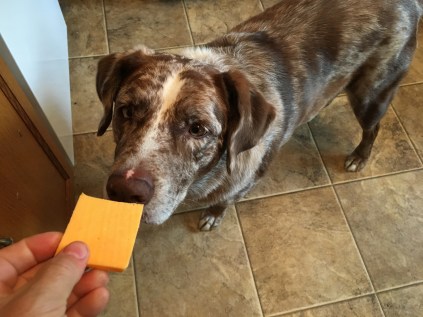
I Am The Cheese Dog

‘This is brand name organic right Karen?’

Sigh. Isn’t that the darndest thing? But I actually do find myself giving all sorts of recommendations on how to deliver medication to a pet. For many of my clients it’s fairly simple : they have a time tested treat that they can hide medication within and especially with the larger breeds of dogs and any garbage hound, down the hatch it goes. Medicine is a treat. For little dogs and those with pushed in faces and cats and birds and turtles and coyotes it can be surprisingly difficult to actually deliver the medication to its intended patient. Think about it. The brachycephalic breeds of dogs (Pugs, Bostons, Bulldogs) have all the body parts of a regular dog, just compressed into about 20% of the space. There’s no extra room in their mouth and they choke and turn blue if you try to get anything past them. Little dogs suffer from Napoleon Complex – they bite you if you try to force something on them. They know the Alligator Roll, too.


Cats? Hoo-boy, cats. We carry one medication for cats stocked in four forms: a tiny tablet, a chewable “gourmed” form, as a liquid and finally as a topical “transdermal” preparation. Yikes. Cat owners in particular are warned not to “dry pill” their cat, meaning do NOT shove a pill down your cat’s throat and forget about it. The pill or capsule may stick partway down, lodging in the folds of the esophagus. Without food or liquid to carry it down to the stomach, the medication may adhere and cause serious inflammation.  Most people have experienced the feeling at least once and don’t wish to repeat it. That’s why we swallow our meds with a glass of water. Esophagitis can affect a cats ability to swallow and in extreme cases lead to strictures or scar tissue in the esophagus. I often recommend that people be prepared to follow a pill with a syringe of warm water. This also helps cleanse the mouth of any aftertaste, making the experience more palatable (very helpful if you must repeat the medication in a few hours!). Feeding canned food afterwards is also effective. Many owners purchase special treats, some with a pocket to house the medication, to pill their pets.  Since medication in some form is almost inevitable for most dogs and cats, keep that in mind during training. Stay ahead of the game. And just to keep the record straight, the only cheese I eat out of a can these days has the word “Nacho” emblazoned across it. 


Christine B. McFadden, DVM

drmc@mcmenagerie.com 
The Raw Movement

There has been a call for us to return to the simpler life, back towards the days when all things were more “natural”. Sounds healthier, yes? “Natural equals healthy” they shout. Raw milk for the family and raw meat for the dog. Ummmmmm. Not always. I myself am happy to be the beneficiary of many scientific discoveries. Let’s take a look.

In 1928, Penicillin, the first true antibiotic, was discovered. An antibiotic is a medicine that destroys bacteria and other microorganisms (germs). Prior to that, the average life expectancy for a person was around 48 years of age. Before antibiotics people and animals often died from infection. Childbirth, surgery, and many diseases were often a death sentence because of the attendant infection. In the year 2019, the average person may expect to live until they are 80 years of age. Why the change? In large part, because of the decrease in deaths from infectious diseases. Antibiotics, Vaccinations, Disinfectants and Sterilization, improved hygiene. Thank you, research scientists!

In 1950 over half the American population lived on farms. Over the next 20 years farms and the multi-party line telephone would disappear as young people moved to the cities and family farms consolidated into mega-businesses. Suburbia was born. Also in flux was how we viewed and cared for our pets. There are fewer working dogs today, and their work has evolved from livestock assistance on the farm into service roles, stepping in to assist people with physical or emotional disabilities. Dogs and cats are recognized for the vital role they play in our everyday lives. We want to care for them the very best that we can, and how we feed them has come under scrutiny as we question our own diet.

It’s true that wolves, foxes and other wild canidae eat raw meat. The average life expectancy of a wolf in the wild is 6-8 years. In captivity, a wolf may live 16-18 years. A wild fox may live 2-5 years; captive, 14 years. Wildlife face a host of “natural” hardships: starvation, infection from contagious diseases (no vaccinations!), infection from wounds and parasites. This is life at its most natural. Most pet dog breeds have been domesticated for centuries. Most can expect to live 10-15 years.

It’s interesting to me that the raw food which people purchase to feed their dog is still a processed food (unless you’ve farmed and slaughtered the meat yourself), susceptible to all the bacterial infections they’re supposed to be trying to avoid.  Raw meat can be contaminated by listeria, salmonella, E Coli, campylobacter and more. What is interesting is that the proponents of RAW claim healthier coats or more energy – not a longer life or true overall health. One on-line site stated that a benefit to feeding a raw diet was that you had total control of what was included in your dog’s food – laughable! We are all aware of the food recalls for both human and animal products : listeria in cheese, E coli in spinach, campylobacter in chicken, salmonella and listeria in commercial raw dog foods.

The truth is : Bacteria aren’t going away. Like us, they fight for survival. They mutate and re-form and will turn up again and again. The Center for Disease Control (CDC), our national public health institute in Atlanta, Georgia, has a battalion of researchers and scientists that follow disease trends throughout the United States and around the world. They’re work is to safeguard us – sometimes from ourselves.

When a client requests advice on what to feed their pets I have a stock answer : Go with the tried and true. Go with a company that has been making pet food for decades, with decades of investment into research of breed needs, life stage requirements, and years of following pets to monitor their health, making any necessary adjustments to their foods along the way. They have invested their livelihood in formulating foods to help your pet to thrive. Often there are a variety of choices within each brand, with ingredient modification to meet the financial abilities of the buyer while still providing decent nutrition for the pet. Bon appetit!

Christine B. McFadden, DVM

drmc@mcmenagerie.com

My Christmas-motif salad wreath emoji

My staff said they needed to speak with me this afternoon. Well, of course. Had we not just enjoyed a dinner and dancing together on Saturday to celebrate the holidays? I met their loved ones. We shared food together. There were contests and prizes and drinkable holiday cheer and overall it was quite the festive occasion. With a day in between to recuperate, everyone was at their sparkly best back at work.

Monday started with a raccoon from the zoo. Her swollen cheek was returning to normal and no abscessed teeth were found, so we shipped her back to the zoo. We tackled two broken legs, a cat and a Great Pyrenees puppy. Both are expected to heal. We saw several birds. One, an enormous 30-year-old Blue and Gold Macaw parrot, screams the entire time we work with him. Oh, sorry, you heard him, too? My ears are still ringing. He was having his annual exam and a nail trim, for pete’s sake. We tended to an elderly rabbit whose x-rays revealed severe arthritis in the lower spine. We prescribed both an anti-inflammatory medication and one for nerve pain (neuropathy). We enjoyed a visit (with vaccinations) with a young Shepherd puppy that just found its Forever Home.

Good news arrived on another front : A 7 pound little stray with breast nodules and rotting teeth had been adopted. For Christmas this little dog not only found a Good Samaritan (shout out to the Stouts!) to address all of her considerable medical needs, but today the biopsy of the breast masses showed that they were benign! With no evidence of a deeper cancer, she can look forward to many healthy years to come. (Side note: I’ve said it before, but can’t help point it out again: Older unspayed female dogs run a 25-percent risk of developing breast cancer, usually malignant. Have your puppy “fixed” while she’s young to prevent this. It really is that simple.).

I fielded questions about pet snakes, lice on rats, a pet pig, and found time to do a little surgery. So when my staff flagged me down I slowed down to give them my attention. “DrMac, when you send an emoji on your phone, do you think you’re sending a Christmas wreath?” First I had to redirect my mind, away from veterinary medicine and onto “emoji”.

Just in case you’ve spent the last 20 years stuck in a Jumanji game, an “emoji” is a cute little symbol meant to convey a person’s thoughts or facial expressions or a symbol. Emoji’s can be inserted into a conversation during text messaging on the ubiquitous cell phones. You needn’t say you are happy, you can simply send a smiley face. Same with “sad”, “embarrassed” and a host of other feelings. These little cell phone symbols also pop up unexpectedly, as your “smartphone” detects the theme in a sentence and suggests a complementary emoji. A turkey showed up around Thanksgiving on my phone, and with the advent of the Christmas holidays, I noted a tree symbol pop up, trimmed in holiday ball ornaments, and another of a Christmas wreath.

So I began to include a Christmas tree in my text messages, whether or not it was pertinent to the conversation. I was being festive. As soon as I saw the wreath, I began to send that out, also, alternating one with the other.

On Monday afternoon this non-medicine related question came out of left field and I took a moment to adjust. Yes, I admitted, I’ve been sending out text messages with Christmas wreaths. I was puzzled.

Three of them began to howl, collapsing into themselves with laughter, barely able to sputter out “You’ve been sending salads!”

What?

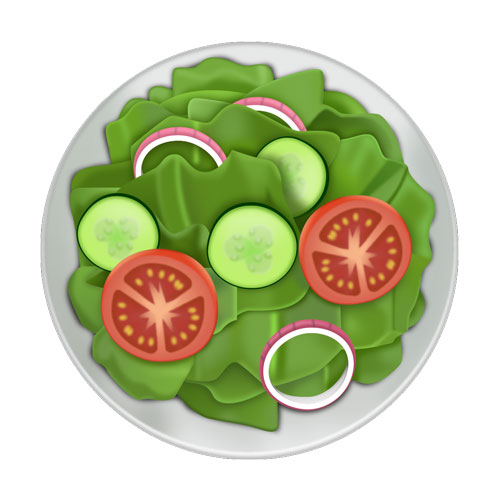
The sad truth came out. Those tiny little colored balls decorating my “wreath” were cucumber and tomato slices. Worse, when the emoji was sent from my I-phone to an android phone, it transformed into a bowl of….salad. Not remotely wreath-like. Well, you can’t let little things like this get you down. I have now sent out a text to my nearest and dearest saying “Greetings! I’m sending you my exclusive Christmas-motif salad wreath emoji, which I mistakenly thought was the accompaniment to the tree….” So here’s to happy holidays to all and if I send you a salad wreath just enjoy it, ok? Related image Image result for salad emoji

Christine McFadden holds a license to practice veterinary medicine and surgery. She has cared for the family pets of Merced at Valley Animal Hospital for more than 30 years. Send questions or comments to drmc@mcmenagerie.com.

The French Fry Challenge

Beware! Traveling veterinarians are everywhere!

Along with the vast hordes of people who undergo summer migration in odd patterns they refer to as “vacations,” we made our way across the North Pole to Europe, specifically France.

You may (or may not) recall that we had entertained an exchange student from that country earlier this year and that she had left us with the declaration (politely) that no where on Earth could the fabulous French Fry be found as it existed in her country, specifically the north of France.

The gauntlet had been thrown. Valiantly I threw all my free air miles into the purchase of plane tickets and we set off on our summer adventure. Our first venture with the French pommes frites (french fry) was …. drum roll, please : at an airport McDonald’s. Oooh la la!

Oddly enough, they tasted like a McDonald’s french fry here. Except they were accompanied by a lime green packet of “pommes-frites-sauce” which was a mysterious white color inside and tasted a bit like sweetened mayonnaise (if you’ve ever had sweetened mayonnaise?).

We passed. It must be an acquired taste, and in all fairness, we had to ask for ketchup everywhere we went, but they did have it.

I suspect when the shoe is on the other foot and the French are visiting us, we may not be so accommodating. We sampled the frites in Paris and across the south of France, then headed north to Lille, almost on the border with Belgium.

Here we met up with our exchange student, whose family welcomed us into their home. We sampled “les frites” in restaurants and roadside stands across Northern France and into Belgium. We ate them with dishes whose names we couldn’t pronounce and sometimes ingredients we couldn’t guess at.

We ate them wrapped in newspaper cones, served in clever tiny wire baskets and scattered across plates. Without exception they were served fresh from the fryer, hot enough to burn the skin off your fingers and tongue, and were indeed crispy/crunchy on the outside and soft and melting on the inside (or was that my tongue giving way?).

With a deep bow of respect, may I say that round one went to northern France in the “Pommes Frites Contestation.”

Wish this could become an annual event! We made the acquaintance of their cat, Plume, and several other pets along the way. We very much enjoyed our trip to another country and found ourselves, delightedly, also happy to come home.

There was much fun with “bonjour” and the French kiss, kiss greeting upon our return and then I got down to work. What a joy! I truly love my work and the people with whom I work.

In my absence, at the Applegate Zoo, our new Black-tailed Mule deer, Lily, had birthed twin fawns! Lily came to our Zoo only weeks before giving birth. She had been taken in by Fish and Game staff after reports of a deer coming up to people in traffic and trying to climb into their cars or mooch something to eat.

Obviously she had been hand-raised (surreptitiously, not legally) then released. Too imprinted on humans to live safely in the wild, Lily found a home here with us, where Donna, the head Zookeeper, watched over her vigilantly and assisted in the twins’ safe delivery on June 15.

Mule deer have a gestation period of about 200 days (compared with a human pregnancy of 280 days). Anxious that the mother and babies bond, Donna kept everyone away initially – not to worry, the little ones are as wild as the proverbial March hares! Right now they have their spots and are slightly smaller than the rooster they share a pen with. Both little does, the fawns will be able to stay with their mother at the Zoo.

Please come visit our City of Merced Applegate Zoo to welcome these newcomers and celebrate summer! A lively Special Celebration is offered this Sunday, July 22 from 10:30 a.m. to 1 p.m. at the Applegate Zoo. Meet the twins! A bounce house, water games, snow cones, popcorn and more will be offered.

Kids : Wear your swimsuits, shoes and shorts required! The zoo address is 1045 West 25th St. in Merced. Free parking.

Christine McFadden, DVM

The Large Animal Vet


Perhaps the title sounds misleading. A “large animal” vet develops a veterinary practice caring for the needs of livestock such as cattle (dairy or beef), sheep, goats and pigs. A “small animal” veterinarian like me is usually slotted into the care of companion pets such as dogs and cats. So when I examine a 200 pound dog, it is still a small animal and likewise there is often confusion about whom to call when the patient is a pot-belly/miniature pig. Not me.


The life of a small animal vet and that of a large animal practitioner are markedly different. One works almost exclusively indoors, dressed neatly, white coat in place. The other weathers life outdoors, facing extremes of blazing heat to icy cold, rain and snow. One always has a sink handy to tidy up. The other uses outdoor hoses more than they’d like. A dairy vet may check over 100 head of cattle in a morning and four “farm calls” make a full day. A small animal vet may follow the medical strands of more than 25 patients a day, winding through exams, blood results, x-rays and working in a surgery or two.  All juggle the demands of unexpected emergency work.


Being in an office most of the day, I rarely interact with my brother and sister large animal veterinarians. So when the pygmy goat from the petting zoo fell over dead I was unhappy, but proceeded to perform a post-mortem examination and sent tissue samples off to our regular lab. I had overseen the care of these goats for many years, but they were on the back burner when it came to my interest in the truly exotic Zoo collection. My concerns centered on whether or not the public might have fed something odd to the goat? (I’ll jump ahead here : No. The public did not harm the goat). I mulled over the problem but prepared to wait until the pathology report was finished sometime in the next week. And then another goat died.


I was unnerved. The goats were being closely watched and none had shown any outward signs of sickness. They had all lived for more than 8 years at the Zoo and had never, collectively, suffered a single injury amongst themselves. I immediately sought the expertise of a Large Animal veterinarian. The Goat Expert was on a dairy farm. The return call came in as I was finishing one surgery and about to start another. Gloves still on, I was staring at some x-rays

in-between these surgeries when they told me they had Dr. B on the line. Multi-tasking at its best.


I hurried over, snapping gloves into the waste receptacle and grabbing pen and paper. I introduced myself and LAUNCHED into a recital of my goat woes. I verified that he had goat experience? Yes. I gave him dates, genders, date of deaths, lack of lab results, still pending. I drew breath to spew forth another list of details and heard him gently respond, “Yes…. I think…. I might be able…. to help”. His measured tones were from a man used to the gentle rhythms of milking machines, contented cows swishing their tails, chewing their cuds. Da-dum da-dum to my staccato dop-dop-dop-dop-dop! I managed to squeeze in a few more hurried sentences (surgery! Waiting!) before he responded calmly, “I think I drive past your practice on my way up from this dairy….”. I opened my mouth. Closed my mouth. I could hear the clouds, feel the sunshine, almost see the shining black and white hides of the gentle Holsteins he surveyed as we spoke. It was all there in the rhythm of his speech. I told myself to stop yapping before he decided my goat problem would be too stressful for him to bother with.


An hour later Dr. Thomas Bauman drove up in a large truck outfitted for all manner of veterinary ministrations. He spent an hour and a half doing a post-mortem on one goat. He had a wicked knife and mulled over the cause of sand in the stomach. He felt it was too much. Did we feed on the ground? No. But little kids feed the Zoo goats oat hay pellets and they often dropped to the sand, with all the goats scrambling to get their share. Hmmm. He gave the problem his full attention and we submitted a gazillion samples to the State Lab, including an intact eyeball because it would be useful for trace metal analyses. The final answer was a copper deficiency in the feed, to which Pygmy goats are especially susceptible. Hay grown in the San Joaquin Valley is often deficient in copper. The salt lick fed at the Zoo did not have added copper because Alpacas are in with the goats and they are susceptible to copper toxicity (too much) if supplemented. So we now feed our goats little capsules of copper wire every six months and all is good. But sometimes I find myself wishing that I was a Large Animal veterinarian. Just so I could slow down and smell the …..never mind.


Christine B. McFadden, DVM

drmc@mcmenagerie.com