Stayner and Queenie (A Boy and His Dog)

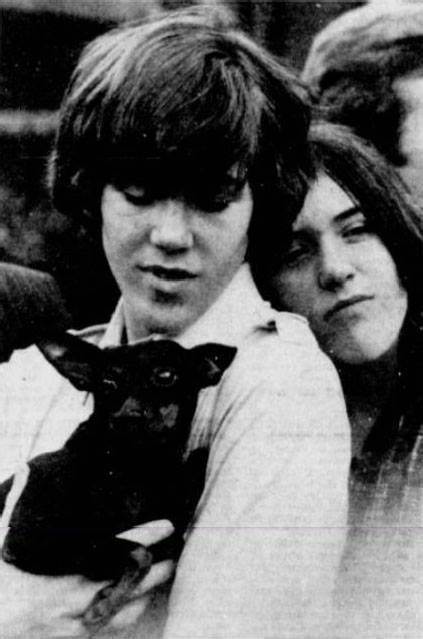
On January 23, 2019 the Merced Sun Star newspaper printed a front page photo that showed both of the Stayner boys together in 1980, shortly after Steven Stayner had been reunited with his family. Steven’s story was remarkable. Steven disappeared when he was 7 years old, simply vanished from his neighborhood one day. It was 1972. Missing for over 7 years, he was reunited with his family only after his captor kidnapped a second child. Steven couldn’t endure seeing this child’s anguish and he hiked the little boy out to a police station. Although rarely mentioned, he also brought with him a dog. The child Steven aimed to rescue ultimately led to his own rescue. It was an incredible story, one that mesmerized the nation. This photograph, taken during the family reunification, shows Steven with his older brother Cary and their father, Delbert Stayner. The portent was only realized in hindsight : one brother, Steven, had saved a life.  Sadly, Steven died an untimely early death in 1989. Ten years later, in 1999, his older brother Cary Stayner was to gain notoriety for committing the unbearable murders of four women. Overall, a very grim and sad story for the family and the town of Merced.

This was a rare photo that captured both Steven and his older brother together, a moment in a time of celebration. But my eyes saw only the dog. Hey! What about Queenie? That’s a picture of Steven and his DOG! She’s right there, just to the side of Delbert Stayner’s elbow! A little black dog with tan legs, Queenie had been with Steven throughout the years of his captivity. She looks happy in this photo, bright eyed.         (Link to Photo from Modesto Bee Here)

I’m a veterinarian. Of course I noticed the dog. That and – I knew Queenie, knew them both, she and Steven. I knew them because I took care of Queenie at her life’s end. That was many years ago. Her importance was to Steven, her passing private. I share a bit of this story because in today’s world we talk about the “human-animal bond”. We use scientific methods to analyze the effects that animals have in sharing our lives. C’mon people – it’s simple : love.

Queenie. Steven was very young, only 7 years old, when he was torn away from home and family. Queenie entered his captive life early on and remained a constant throughout the years to follow. She gave him unwavering loyalty, and non-judgmental constant cheerful companionship. It is notable that when he left that night to return the little boy, Steven never considered leaving his dog behind.

I met Queenie and Steven in late 1982 or early 1983. She was very ill. The little dog looked thin compared to her bloated abdomen. Steven was very quiet. A polite young man, he desperately wanted to save her. I think, in many ways, she had saved him.
Queenie’s abdomen was enlarged due to fluid build up, a condition called ascites and often caused by liver failure. Back in the early 80’s, blood tests, ultrasounds and other diagnostic tests were not readily available in the Central Valley. Neither was overnight care. I lived in Turlock and commuted to my job in Merced that year. So I started Queenie on IV fluids and other medications and drove her home with me that night. I rigged her IV fluids first to my car door strap, then used a coat hanger to suspend them from a towel rack. She was a sweet dog, but had no energy left to fight her illness. Queenie passed away quietly in my living room at home in Turlock. Steven took her from me the next morning. Although no autopsy was performed, I believed she had liver cancer.

Although I saw Steven with other pets after that, we did not have a personal friendship and I lost touch with him over the years. The love that he and Queenie had for each other has stayed in my heart and I was touched to see her once again, that doggie laugh on her face as she forever follows the love of her life, Steven.

Christine B. McFadden, DVM

drmc@mcmenagerie.com

My Husband’s Hospital Vacation

My first indication that text messaging had gone too far in my household was the afternoon I checked my phone and discovered the following message : “Just wanted to let you know. I thought I might be having a heart attack so I checked myself into the hospital.” It had been sent from my husband’s cell phone.


What you need to know were the events preceding this text message. My husband had taken our children skiing two days earlier. On this morning, he had done some moaning and groaning around the house. The problem is, I not only have to get ready for work myself, but I oversee care of the kids, the cats and the chickens before leaving. Getting to school on time is a mountain we climb every day. If it’s not worth opening your mouth to speak up about something, I’m not going to slow down long enough to start an inquiry. He knows where to find his Advil.


I confess I felt more irritation than anxiety when I read the message. Really? I’d had a full day and no lunch up to that point. So I called him. He answered. He sounded cheerful. Enough hours had passed before I’d discovered his message that he could assure me that his chest x-rays, his blood tests and his EKG were all normal and he wasn’t having a heart attack. So why are you still there? I reasoned. Well, he rambled on, this doesn’t explain the pain. “What about arthritis?” I asked. Oh no, he assured me, I’ve never had arthritis here. It’s on my right side. I was driving myself to the golf course and felt pain in my right arm, so I pulled over and googled heart attacks. It said they would be on the left side, but I thought I should be sure. They’re going to run another test to see if I have blood clots. If it’s abnormal, I’ll stay for a CT scan.


OK, honey. I returned to my own patients. There was a cat that had been tumbled in the dryer for 7 minutes. She appeared dazed, with tiny bruises starting to appear on her skin where patches of fur were missing. She was a lucky cat; only last month, another cat had actually died in a similar accident. We began treatment for shock and started the cat on IV fluids.


It was closing time when my husband called. My test is abnormal, he said. “What’s the name of that test, hon?” D-Dimer. We use the D-dimer test in veterinary medicine. Platelets, the cells that help blood coagulate or clot so you don’t bleed out, will slowly break down after they’ve served their purpose. If your body is forming big blood clots where it shouldn’t, the by-product of platelet breakdown will be very high in the blood stream. The D-dimer test measures this level.


For a variety of reasons, I didn’t believe it. So while getting the kids squared away I researched the normal blood levels for humans. Armed with this info, I went down to visit my husband in the ER. He looked remarkably fit. In fact, he wasn’t feeling any pain, though he’d not been given any medication. I asked his nurse for the actual number on his D-dimer test. It was less than 200. I stared at the nurse. “But that’s normal”. Yes, the nurse agreed. I stared at my husband. “Who told you it was abnormal?” He frowned, concentrating. He wasn’t sure (What else did he have to do?). About then they came to wheel him down for his CT scan. They said it would be read that night. Forgive me my skepticism, but having assured myself that my husband was doing very well, I kissed him and told him to enjoy his scan. At this point I reflected that if they did find something wrong with him, it would not be what he’d gone in for. I slept poorly (despite my brave front). At 2:20 in the morning (5 hours later) my husband sent a text message that he had completed his CT scan but it wouldn’t be read until the next day.


I visited him on my way to work the next morning. He was cheerful and even complimentary on the hospital breakfast. They were going to run some more blood tests. I left him to it.


At work, my own patients were well. My dryer tumbled cat looked much better and was enjoying a hearty breakfast herself. Her bloodwork was excellent. By early afternoon I was discharging my patient to her ecstatic owner. Back at the human hospital, my husband had been leaked the information that he had a “non-displaced hairline fracture in his right rib”. My husband was now being offered an echocardiogram and had begun to call me every hour or so. I told him if he couldn’t relieve the babysitter by 3:30 to let me know. If he wanted to stay another night in the hospital that was on him. I was worn out.


Once he knew it was just a cracked rib, my husband felt lots better. I arrived home that night to find he had invited several people to dinner and cooked up a storm. Even better, he could go on his golf vacation next week.


I am SO grateful my patients can’t talk!


Christine B. McFadden, DVM

drmc@mcmenagerie.com

Castor the Police Dog

There are many fine working dogs out there – cattle and sheep dogs, Guide Dogs for the Blind, Special needs assistance dogs, Bomb and Drug dogs, and perhaps one of the finest working groups, the Working Police Dog, or K-9 Cops, complete with their own badge. Hired on by Police and Sheriff departments nationwide, they are largely made up of German Shephard and Belgian Malinois breeds. I have had the honor of working with these dogs for over 30 years. Both local Police Department and Sheriff’s Departments have working dogs, used on the SWAT team, for school protection, building searches, drug deals and of course, criminal apprehension.

Astor was a beautiful sable shepherd. High strung, as so many of these dogs need to be to perform their job, ever alert, he suffered from stomach issues, and his spleen would swell to enormous proportions. We had just gotten in 4 new dogs at the Police Department, and one had already been rejected for a permanent lameness in the right shoulder and returned to the seller. This was at great expense and nerve wracking for the new program. To have problems with another dog was near unbearable. I said he needed to have surgery, to biopsy the intestine and spleen. It was late in the day when his handler came down to visit him in recovery. Though the individual police departments own the dogs, it is their Peace Officer Handlers that live with the dog and develop an intense bond. These dogs – and their handlers – were new to me and I knew very little about them. I was ignorant that even off duty an officer is expected to be prepared to respond to an emergency, so when the handler bent over in post op to greet his dog, I was most startled to note a gun in his waistband! I wondered if he’d planned to shoot me if the surgery hadn’t gone well! (He said no).

Most of the dogs have German names, as many were and still are imported from Germany. Their commands are given in the German Schitzhund or obedience training language. Handlers lucky enough to be assigned a partnership with one of these dogs will spend weeks learning the cues and training required while forming a deep bond. You see, these dogs can go where a person cannot. These dogs serve as the first line of defense when things go bad. No one wants to lose a dog – but better the dog than a Peace Officer. The K-9 Cop can mark a perpetrator in a crowd and run him (or her) down. Once the fleeing person stops, they will stand still, not biting unless the person resists and provokes a bite. They can be sent into buildings with cameras on their backs to locate the offender. They can smell or hear where someone is hidden.

Castor was a Malinois from the Sheriff’s Department. He passed away naturally some years ago. A very “sharp” dog, he was a holy terror when he came into our clinic. He growled at all the staff. He was not walked during his brief stays, as we customarily do with all boarding pets. Except….Castor loved me. There was no rhyme nor reason to it. I poked him with needles, gave shots, drew blood. No problem. At first I wondered if I resembled the handler’s wife, but once I met her, blonde, petite, beautiful, sadly I knew that I did not. Whatever the reason, I was grateful. Castor had many arrests to his name, but my favorite story was the guy swimming in the canal to elude capture. His handler sent the dog, knowing if the guy made it to the far bank he might get away. The criminal decided to drown the dog. Castor took matters into his own hands, simply wrapping his jaws around the only body part he could reach – his neck. The man surrendered.

In the United States Air Force, fighter pilots are accompanied by a “Wingman”, another fighter plane which flies off the right wing and just behind the lead, whose job is primarily to protect the lead by “watching his back”. Our Canine Corps of Peace Officers serve as “Wingman” to the officers they shadow.  May we be humbled by their gifts and grateful for their service.