Cheese Whiz

So I was visiting with a friend when she decided it was time to pill her dog.  This was something new for her and she had questions. “What should I put the pill in?” She’d used peanut butter once before when she gave her dog some medicine. I shrugged. That’s ok. Told her I use bread with my dogs. Bread is something I usually have on hand, it’s cheap, and makes disgusting balls to mold around things like pills. My dogs would crawl through fire for a crust of bread. She opened her fridge (maybe she was out of peanut butter?) and called back from within its depths : “what about cheese?” “Sure”, I said.  She extracted herself from the refrigerator, bringing two slices of cheese with her. Pre-sliced orange cheese. Gotcha. Least it wasn’t in a can (and yes, I ate cheese whiz from a can growing up. Still here). Then she selected one slice and began to wrap up the pill. Sure seemed to be taking a while. The dog was starting to drool and I was my usual impatient self so I reached across to just mush it up, for heaven’s sake, no need to be dainty. In my expert hands the cheese completely crumbled and fell away from the pill. I stared. “What kind of cheese IS this?” I asked suspiciously. She glanced over at me. “Tillamook.” Tillamook? I reeled. Tillamook is some serious cheese. What happened to American Kraft? Where was the CAN, man? This was uncharted territory. Done trying to make silly putty out of real cheese, I simply reached down, opened her dogs’ mouth and pushed the pill and cheese crumbles in, letting the dog lick the last crumbs off my palm.
Real cheese, what a crazy idea. Invalidated my entire childhood’s culinary experiences! 
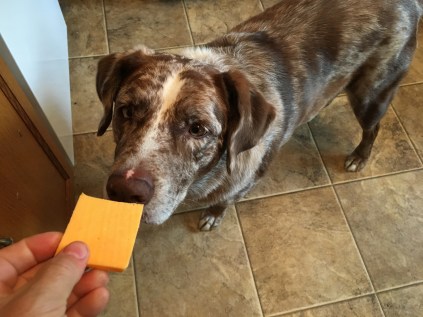
I Am The Cheese Dog

‘This is brand name organic right Karen?’

Sigh. Isn’t that the darndest thing? But I actually do find myself giving all sorts of recommendations on how to deliver medication to a pet. For many of my clients it’s fairly simple : they have a time tested treat that they can hide medication within and especially with the larger breeds of dogs and any garbage hound, down the hatch it goes. Medicine is a treat. For little dogs and those with pushed in faces and cats and birds and turtles and coyotes it can be surprisingly difficult to actually deliver the medication to its intended patient. Think about it. The brachycephalic breeds of dogs (Pugs, Bostons, Bulldogs) have all the body parts of a regular dog, just compressed into about 20% of the space. There’s no extra room in their mouth and they choke and turn blue if you try to get anything past them. Little dogs suffer from Napoleon Complex – they bite you if you try to force something on them. They know the Alligator Roll, too.


Cats? Hoo-boy, cats. We carry one medication for cats stocked in four forms: a tiny tablet, a chewable “gourmed” form, as a liquid and finally as a topical “transdermal” preparation. Yikes. Cat owners in particular are warned not to “dry pill” their cat, meaning do NOT shove a pill down your cat’s throat and forget about it. The pill or capsule may stick partway down, lodging in the folds of the esophagus. Without food or liquid to carry it down to the stomach, the medication may adhere and cause serious inflammation.  Most people have experienced the feeling at least once and don’t wish to repeat it. That’s why we swallow our meds with a glass of water. Esophagitis can affect a cats ability to swallow and in extreme cases lead to strictures or scar tissue in the esophagus. I often recommend that people be prepared to follow a pill with a syringe of warm water. This also helps cleanse the mouth of any aftertaste, making the experience more palatable (very helpful if you must repeat the medication in a few hours!). Feeding canned food afterwards is also effective. Many owners purchase special treats, some with a pocket to house the medication, to pill their pets.  Since medication in some form is almost inevitable for most dogs and cats, keep that in mind during training. Stay ahead of the game. And just to keep the record straight, the only cheese I eat out of a can these days has the word “Nacho” emblazoned across it. 


Christine B. McFadden, DVM

drmc@mcmenagerie.com 

Little Old Ladies

She was a little old lady, short and round as a dumpling. She energetically grabbed her dog from the exam table and tipped him onto his paws. You’d never have guessed her age except for the grey hair. Her dog found his footing and waited expectantly by her feet. “I’ve got to go”, she declared, “I have to decorate the Hall for my sister’s 50th wedding anniversary.” Wow, I marveled, that’s something! A blaze of blue eyes flashed at me. “It’s a pain in the-you-know-what” she said. “My 50th was 2 years ago and every day I wake up and wonder if we’re going to make it.”  She gave me a saucy grin and danced out the door, her dog following her in adoration. I stared after them open-mouthed. Awesome woman.

People and pets share their lives with me. It’s a jumble and a jungle out there, and hanging on to these moments builds a life. On a long work day, I spend more awake time with fellow staff than I do with my family. 

When I’d first started out in town I struggled to put my textbook medical knowledge together with my patient’s needs. My focus was on the animals and I learned their names first. This fact appalled me the day I rounded a clothing carousel at a local store and came face to face with a client. The woman looked up, a smile starting and then fading as I blurted out “Beau!” – not her name at all, but her dogs. Good grief! I worked harder to learn BOTH their names in future but don’t test me on that one. Over the years my brain often refuses to let go of the first impression, the pet we bonded over who is now deceased, so that I continue to call the next dog, or worse, the third or fourth pet that follows, by the original dog’s name. My staff cringes at these mistakes, occasionally alarmed as they search for other signs of dementia. There’s Zoie’s Mom. Oh, she has another dog now. Mrs. R is 87 years old. Last year she took a trip to China with her daughter. Next year they’re thinking of Australia. Zoie was a 10 pound black miniature poodle who had epilepsy and the sweetest disposition you could ask for. Her new dog is 3 years old, but she will always be the “new” dog. When we get together we talk more about Zoie. The new dog is very healthy and we don’t have twelve years of medical battles fought and won to look back upon with her. 

And I have fond memories of the family matriarch, in her 90’s, who put out condensed milk for her cats every day. They were all terribly obese. She confided to me once that if they turned up their nose at a can of food she’d just open another flavor. Sometimes, she said, there would be as many as 7 cans lined up along her porch. I marveled at the ability of our pets to train us. She took in many neighborhood strays and it pleased her to spoil them. She laughed at my dietary advice. Condensed milk had seen her into her 90’s and I wasn’t going to convince her otherwise.  She gave me a chocolate colored blanket she’d hand crocheted. I have it yet.

old ladydog-walking-4426782.jpg

It was a little old lady who taught me about the bluing older woman used to take the grey out of their hair and make it lustrous white. True, sometimes it turned their hair a delicate blue. This invaluable knowledge helped me make white poodles whiter. 

I’ll be a little old lady someday. I’ll hoard cats and keep too large of a dog and goodness knows what other kinds of critters. I plan to wear purple with a red hat and act up just like those women in the Red Hat Society, because I love the poem by Jenny Joseph. And to all the older women who have shared their pets and their lives with me, thank you for enriching my days and just for being you.


Christine B. McFadden, DVM

drmc@mcmenagerie.com
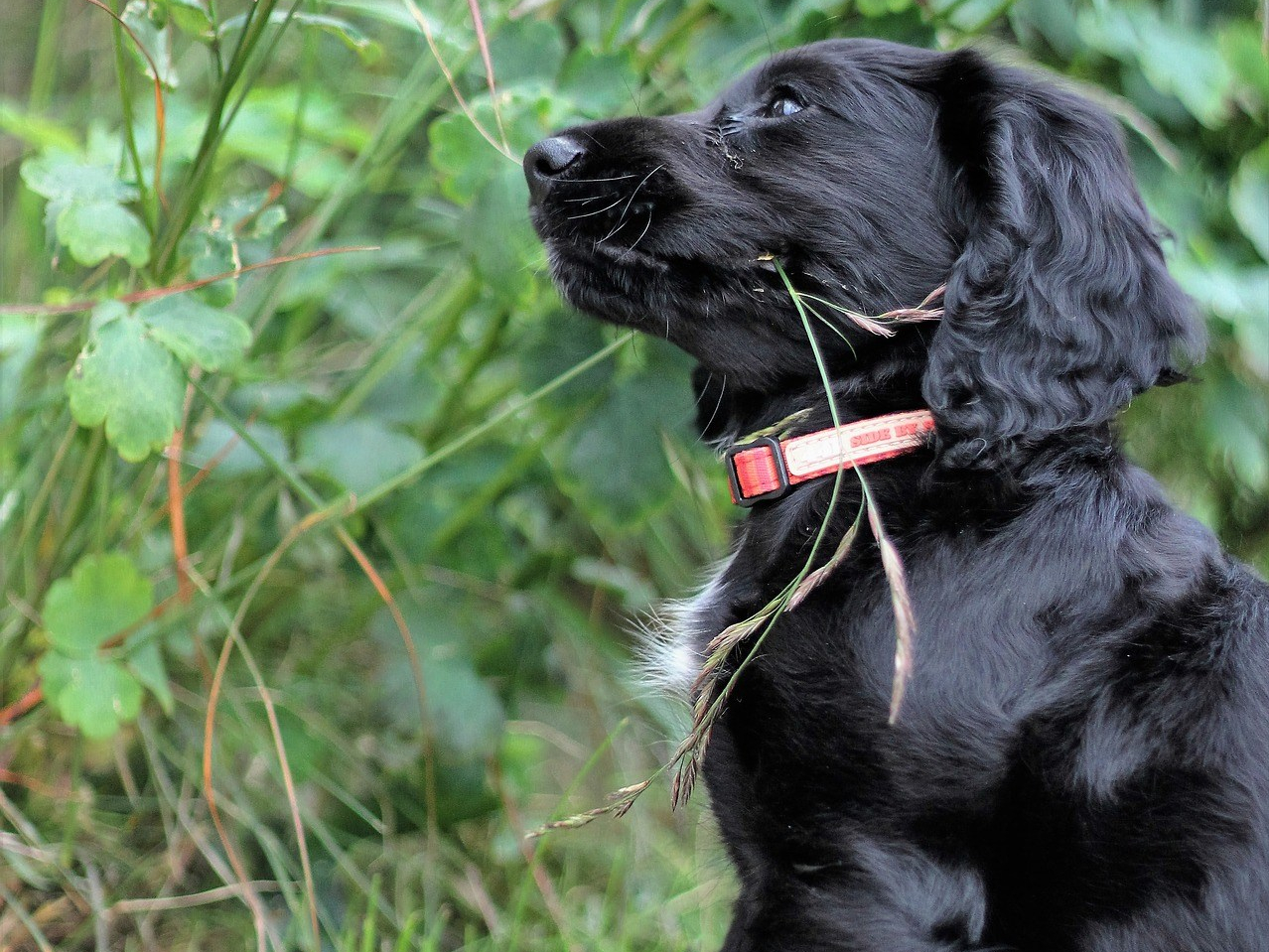
Molly and the Spider Plant

It was Molly who reminded me. Molly is an English Springer Spaniel. Her soft, silky black ears make it irresistible to gently pull them. Her owner was bewailing the fate of her garden, as young Molly had developed a fascination for a particular potted spider plant. She sought my advice.

MollyandtheSpiderPlant

My mind went drifting back to my third Irish Wolfhound, named Shredder. ( You can see photos of Shredder and I on my Facebook Page) If there can be karma in the name you give your dog then he was blessed with boatloads of karma. He lived up to his name. The glue on envelopes fascinated him, and given his size, no kitchen counter was safe for the deposition of mail. He took what he pleased and to this day I blame him for receiving a 5 day cut-off notice from the electricity people. He’s the only dog I’ve ever had who actually did eat the children’s homework. No one laughed. But the real pain in the neck was his attitude towards a tiny potted lemon tree I had started on the back patio. One morning, as I made my garden rounds, I noticed that the tree was a little crooked. Doubtless the dirt was settling, so I carefully righted it, tamping the soil down gently at the base. A few days later I noted it was tilted again. Puzzled, I again returned it to its proper position. As the days passed, I began to realize a pattern here, namely that the tree was being knocked sideways again and again. I was righting it on a daily basis! And then I caught him, Shredder, with a lemon leaf in his mouth, grinning happily, tail wagging. Such fun! Sigh.

So I moved the plant. Nope. Now, as a veterinarian, I had lots of training for behavioral problems. This was drummed into us students as very important, because poor animal behavior can lead straight to the Pound. I became annoyed. I staked the tree with a bamboo stake. Apparently this was not deemed fair play by the dog and next morning I found the tree completely sideways, a branch broken. I righted it. He knocked it sideways. Finally I took metal rebar, settled the tree more deeply in the pot, and firmly staked the trunk every few inches. Satisfied that I had prevailed, I went to bed.

The following morning the lemon tree was nowhere to be seen. When it was no longer fun, Shredder had simply removed the entire plant and shredded it. Who says dogs don’t have a sense of humor?

I did not share this story with Molly and her owner. I wanted them to have confidence in my advice. But when next I saw her, Molly had become truly devious. She not only enjoyed her spider plant but had branched out to include ALL the potted plants. I understood her owner’s angst. I wished I had a fabulous know-it-all answer. There are special Behaviorists in the field of veterinary medicine. They listen for hours to your problems and have reams of questionnaires to fill out. They have many inventive cures to modify and “cure” your dog of his or her behavioral problems. Most of them involve owner intensive time: “Take your dog for a 5 mile walk twice a day, he’ll be tired out and have less energy”(me, too); “Tell him no! sharply every time he goes near your plant, then distract him with a fun activity” (but I needed to run to the grocery store, I won’t be home to distract him); “Use the dimes or rocks-in-the–tin-can method” (but first, how do you really securely seal the thing and second, my aim REALLY is that poor – ouch!). Somehow, behaviorists always have the answers and most of it involves time that most of us don’t have – or the dog wouldn’t be doing it to begin with, right? Fence either your dog or your plants in (expensive! Not attractive!).

In the end, I wanted to tell her to dump the spider plants and try roses. It’s karma. You see, one of the meanings associated with the name “Molly” is “rebellion”. They should have looked it up first.

Christine B. McFadden, DVM

drmc@mcmenagerie.com
Connect with me on Facebook for shared photos and more!

Ronda and the Very Bad Paw

It was late in the day when the Animal Control Officer from the City of Merced Police Department brought us a stray cat that was in trouble. This service is provided to injured stray animals in the City, and it is up to us to determine if they can be helped or, sometimes, to help end their suffering. This little grey cat weighed in at 7 pounds and had a left front paw mildly swollen from what appeared to be a bite wound. She was running a fever, almost 104 degrees F, but was purring and in general seemed very happy to have been found. We shaved her wound; the paw didn’t look too bad. We could help her.

Under anesthesia I opened the abscess so that the pus could drain out, using a sterilized rubber band to act as a seton or drain to keep the tiny wound open for healing; otherwise it might close up too quickly, sealing bacteria inside and the abscess would not resolve. The cat was temporarily named “Ronda” by the staff, given an antibiotic injection and some subcutaneous fluids for her fever and placed in a cage with her own comfy blanket.

End of story, yes? I moved on to other patients, leaving the daily nursing to our extremely capable nursing staff. When no one claimed Ronda after several days, we approached the local Rescue Group, New Beginnings For Merced County Animals, to ask if they might be able to find a home for her. They agreed to take her in. New Beginnings was founded over 11 years ago by a remarkable local woman, Sharon Lohman. The non-profit organization works with over 70 volunteers and pet Foster parents to find homes and care for well over 5,000 dogs and cats each year. It is estimated that they have saved the lives of up to 75% of the dogs who enter our local shelters.

Well, Ronda’s story didn’t end with that first minor surgery. Her swollen paw didn’t respond to treatment. Irritating. Abscesses like this just aren’t that medically challenging. I threw a second, high powered antibiotic at her, and added twice daily foot soaks in antibacterial wash. Kindergarten medicine! Open an abscess up, drain it, and voila, they practically heal themselves! Ronda, however, hadn’t read that medical bulletin. Pus was leaking around the drain, but her paw wasn’t healing. We tested her for the feline leukemia/FELV and feline aids/ FIV viruses, in case Ronda was immunosuppressed. She tested negative for both (and people CANNOT get HIV or AIDs from cats).

Eight days after she had been admitted, Ronda was still there, her paw enormous! We took x-rays, looking for signs of abnormal bone tissue, maybe a sliver of metal acting as a foreign object. Zilch. Normal. I was worried that Rescue wouldn’t take her. (They do a lot of fundraisers, but sometimes it comes down to “do you want THIS animal, or will helping 5 others be better?”). Now we were discussing amputating her front leg to save her life. I was furious with that paw. Because of the progression, I was certain that I was dealing with an anaerobic bacteria, one that didn’t require oxygen to grow. These bacteria can be difficult to kill. I asked for the weekend, and told Ronda she had one last chance.

I took her to surgery again. Knowing that I had to expose all possible tissue to oxygen, leaving no place for bacteria to hide, I literally dug through each toe, around each pad. I placed two ¼ inch penrose drains (don’t ask me how) in that tiny paw. I added on an antibiotic better known for fighting anaerobic infections and we all sat back and held our breath. In 48 hours her paw was fine. Ronda kept her leg, healed quickly from that point on and went to her new home. Lesson re-learned: Never assume.

Christine B. McFadden, DVM

drmc@mcmenagerie.com

Follow drmcsveterinarytales on Facebook for even more!

My Husband’s Hospital Vacation

My first indication that text messaging had gone too far in my household was the afternoon I checked my phone and discovered the following message : “Just wanted to let you know. I thought I might be having a heart attack so I checked myself into the hospital.” It had been sent from my husband’s cell phone.


What you need to know were the events preceding this text message. My husband had taken our children skiing two days earlier. On this morning, he had done some moaning and groaning around the house. The problem is, I not only have to get ready for work myself, but I oversee care of the kids, the cats and the chickens before leaving. Getting to school on time is a mountain we climb every day. If it’s not worth opening your mouth to speak up about something, I’m not going to slow down long enough to start an inquiry. He knows where to find his Advil.


I confess I felt more irritation than anxiety when I read the message. Really? I’d had a full day and no lunch up to that point. So I called him. He answered. He sounded cheerful. Enough hours had passed before I’d discovered his message that he could assure me that his chest x-rays, his blood tests and his EKG were all normal and he wasn’t having a heart attack. So why are you still there? I reasoned. Well, he rambled on, this doesn’t explain the pain. “What about arthritis?” I asked. Oh no, he assured me, I’ve never had arthritis here. It’s on my right side. I was driving myself to the golf course and felt pain in my right arm, so I pulled over and googled heart attacks. It said they would be on the left side, but I thought I should be sure. They’re going to run another test to see if I have blood clots. If it’s abnormal, I’ll stay for a CT scan.


OK, honey. I returned to my own patients. There was a cat that had been tumbled in the dryer for 7 minutes. She appeared dazed, with tiny bruises starting to appear on her skin where patches of fur were missing. She was a lucky cat; only last month, another cat had actually died in a similar accident. We began treatment for shock and started the cat on IV fluids.


It was closing time when my husband called. My test is abnormal, he said. “What’s the name of that test, hon?” D-Dimer. We use the D-dimer test in veterinary medicine. Platelets, the cells that help blood coagulate or clot so you don’t bleed out, will slowly break down after they’ve served their purpose. If your body is forming big blood clots where it shouldn’t, the by-product of platelet breakdown will be very high in the blood stream. The D-dimer test measures this level.


For a variety of reasons, I didn’t believe it. So while getting the kids squared away I researched the normal blood levels for humans. Armed with this info, I went down to visit my husband in the ER. He looked remarkably fit. In fact, he wasn’t feeling any pain, though he’d not been given any medication. I asked his nurse for the actual number on his D-dimer test. It was less than 200. I stared at the nurse. “But that’s normal”. Yes, the nurse agreed. I stared at my husband. “Who told you it was abnormal?” He frowned, concentrating. He wasn’t sure (What else did he have to do?). About then they came to wheel him down for his CT scan. They said it would be read that night. Forgive me my skepticism, but having assured myself that my husband was doing very well, I kissed him and told him to enjoy his scan. At this point I reflected that if they did find something wrong with him, it would not be what he’d gone in for. I slept poorly (despite my brave front). At 2:20 in the morning (5 hours later) my husband sent a text message that he had completed his CT scan but it wouldn’t be read until the next day.


I visited him on my way to work the next morning. He was cheerful and even complimentary on the hospital breakfast. They were going to run some more blood tests. I left him to it.


At work, my own patients were well. My dryer tumbled cat looked much better and was enjoying a hearty breakfast herself. Her bloodwork was excellent. By early afternoon I was discharging my patient to her ecstatic owner. Back at the human hospital, my husband had been leaked the information that he had a “non-displaced hairline fracture in his right rib”. My husband was now being offered an echocardiogram and had begun to call me every hour or so. I told him if he couldn’t relieve the babysitter by 3:30 to let me know. If he wanted to stay another night in the hospital that was on him. I was worn out.


Once he knew it was just a cracked rib, my husband felt lots better. I arrived home that night to find he had invited several people to dinner and cooked up a storm. Even better, he could go on his golf vacation next week.


I am SO grateful my patients can’t talk!


Christine B. McFadden, DVM

drmc@mcmenagerie.com

Castor the Police Dog

There are many fine working dogs out there – cattle and sheep dogs, Guide Dogs for the Blind, Special needs assistance dogs, Bomb and Drug dogs, and perhaps one of the finest working groups, the Working Police Dog, or K-9 Cops, complete with their own badge. Hired on by Police and Sheriff departments nationwide, they are largely made up of German Shephard and Belgian Malinois breeds. I have had the honor of working with these dogs for over 30 years. Both local Police Department and Sheriff’s Departments have working dogs, used on the SWAT team, for school protection, building searches, drug deals and of course, criminal apprehension.

Astor was a beautiful sable shepherd. High strung, as so many of these dogs need to be to perform their job, ever alert, he suffered from stomach issues, and his spleen would swell to enormous proportions. We had just gotten in 4 new dogs at the Police Department, and one had already been rejected for a permanent lameness in the right shoulder and returned to the seller. This was at great expense and nerve wracking for the new program. To have problems with another dog was near unbearable. I said he needed to have surgery, to biopsy the intestine and spleen. It was late in the day when his handler came down to visit him in recovery. Though the individual police departments own the dogs, it is their Peace Officer Handlers that live with the dog and develop an intense bond. These dogs – and their handlers – were new to me and I knew very little about them. I was ignorant that even off duty an officer is expected to be prepared to respond to an emergency, so when the handler bent over in post op to greet his dog, I was most startled to note a gun in his waistband! I wondered if he’d planned to shoot me if the surgery hadn’t gone well! (He said no).

Most of the dogs have German names, as many were and still are imported from Germany. Their commands are given in the German Schitzhund or obedience training language. Handlers lucky enough to be assigned a partnership with one of these dogs will spend weeks learning the cues and training required while forming a deep bond. You see, these dogs can go where a person cannot. These dogs serve as the first line of defense when things go bad. No one wants to lose a dog – but better the dog than a Peace Officer. The K-9 Cop can mark a perpetrator in a crowd and run him (or her) down. Once the fleeing person stops, they will stand still, not biting unless the person resists and provokes a bite. They can be sent into buildings with cameras on their backs to locate the offender. They can smell or hear where someone is hidden.

Castor was a Malinois from the Sheriff’s Department. He passed away naturally some years ago. A very “sharp” dog, he was a holy terror when he came into our clinic. He growled at all the staff. He was not walked during his brief stays, as we customarily do with all boarding pets. Except….Castor loved me. There was no rhyme nor reason to it. I poked him with needles, gave shots, drew blood. No problem. At first I wondered if I resembled the handler’s wife, but once I met her, blonde, petite, beautiful, sadly I knew that I did not. Whatever the reason, I was grateful. Castor had many arrests to his name, but my favorite story was the guy swimming in the canal to elude capture. His handler sent the dog, knowing if the guy made it to the far bank he might get away. The criminal decided to drown the dog. Castor took matters into his own hands, simply wrapping his jaws around the only body part he could reach – his neck. The man surrendered.

In the United States Air Force, fighter pilots are accompanied by a “Wingman”, another fighter plane which flies off the right wing and just behind the lead, whose job is primarily to protect the lead by “watching his back”. Our Canine Corps of Peace Officers serve as “Wingman” to the officers they shadow.  May we be humbled by their gifts and grateful for their service.

My Christmas-motif salad wreath emoji

My staff said they needed to speak with me this afternoon. Well, of course. Had we not just enjoyed a dinner and dancing together on Saturday to celebrate the holidays? I met their loved ones. We shared food together. There were contests and prizes and drinkable holiday cheer and overall it was quite the festive occasion. With a day in between to recuperate, everyone was at their sparkly best back at work.

Monday started with a raccoon from the zoo. Her swollen cheek was returning to normal and no abscessed teeth were found, so we shipped her back to the zoo. We tackled two broken legs, a cat and a Great Pyrenees puppy. Both are expected to heal. We saw several birds. One, an enormous 30-year-old Blue and Gold Macaw parrot, screams the entire time we work with him. Oh, sorry, you heard him, too? My ears are still ringing. He was having his annual exam and a nail trim, for pete’s sake. We tended to an elderly rabbit whose x-rays revealed severe arthritis in the lower spine. We prescribed both an anti-inflammatory medication and one for nerve pain (neuropathy). We enjoyed a visit (with vaccinations) with a young Shepherd puppy that just found its Forever Home.

Good news arrived on another front : A 7 pound little stray with breast nodules and rotting teeth had been adopted. For Christmas this little dog not only found a Good Samaritan (shout out to the Stouts!) to address all of her considerable medical needs, but today the biopsy of the breast masses showed that they were benign! With no evidence of a deeper cancer, she can look forward to many healthy years to come. (Side note: I’ve said it before, but can’t help point it out again: Older unspayed female dogs run a 25-percent risk of developing breast cancer, usually malignant. Have your puppy “fixed” while she’s young to prevent this. It really is that simple.).

I fielded questions about pet snakes, lice on rats, a pet pig, and found time to do a little surgery. So when my staff flagged me down I slowed down to give them my attention. “DrMac, when you send an emoji on your phone, do you think you’re sending a Christmas wreath?” First I had to redirect my mind, away from veterinary medicine and onto “emoji”.

Just in case you’ve spent the last 20 years stuck in a Jumanji game, an “emoji” is a cute little symbol meant to convey a person’s thoughts or facial expressions or a symbol. Emoji’s can be inserted into a conversation during text messaging on the ubiquitous cell phones. You needn’t say you are happy, you can simply send a smiley face. Same with “sad”, “embarrassed” and a host of other feelings. These little cell phone symbols also pop up unexpectedly, as your “smartphone” detects the theme in a sentence and suggests a complementary emoji. A turkey showed up around Thanksgiving on my phone, and with the advent of the Christmas holidays, I noted a tree symbol pop up, trimmed in holiday ball ornaments, and another of a Christmas wreath.

So I began to include a Christmas tree in my text messages, whether or not it was pertinent to the conversation. I was being festive. As soon as I saw the wreath, I began to send that out, also, alternating one with the other.

On Monday afternoon this non-medicine related question came out of left field and I took a moment to adjust. Yes, I admitted, I’ve been sending out text messages with Christmas wreaths. I was puzzled.

Three of them began to howl, collapsing into themselves with laughter, barely able to sputter out “You’ve been sending salads!”

What?

The sad truth came out. Those tiny little colored balls decorating my “wreath” were cucumber and tomato slices. Worse, when the emoji was sent from my I-phone to an android phone, it transformed into a bowl of….salad. Not remotely wreath-like. Well, you can’t let little things like this get you down. I have now sent out a text to my nearest and dearest saying “Greetings! I’m sending you my exclusive Christmas-motif salad wreath emoji, which I mistakenly thought was the accompaniment to the tree….” So here’s to happy holidays to all and if I send you a salad wreath just enjoy it, ok? Related image Image result for salad emoji

Christine McFadden holds a license to practice veterinary medicine and surgery. She has cared for the family pets of Merced at Valley Animal Hospital for more than 30 years. Send questions or comments to drmc@mcmenagerie.com.

Marijuana Toxicosis

Now it is possible that some of you may succumb to the same little habit I am guilty of: reading the popular magazines while standing in line at the grocery store. Never buying them, of course. This is where I follow the stars (we aren’t talking astronomy here) and gather knowledge of my fellow human beings. Consider it human resource research. It doesn’t take many pages for me to feel that I have gleaned everything of interest that one of these magazines might offer, so imagine my surprise when I came across an entire page devoted to the subject of: “What’s In My Bag?” It is actually believed to be of interest to American readers to know what a Hollywood actress might carry in her purse. I am stuck on that: who cares and why? First, I decided to look in my own purse. I have one, though I rarely carry it.  Wallet, ID, keys. A pen. Sometimes I have actual money in there, sometimes not. I cannot imagine this being of interest to anyone else. Even potential purse snatchers have divined that it’s not worth their time.

Now, if I was going to be interviewed for a magazine with full page glossies, would I lie and embellish all that? You bet. Do people really carry extra shoes, whole bottles of water, and apples in their purses? Why don’t THEIR apples bruise after being jostled in a bag with shoes all day long? Are those shoes… gym shoes? Ewww. Is it possible that I am the only person in the world who doesn’t carry protein bars as their snack, sweetened preferably with honey or agave or stevia leaves, no white sugar please? Help! These women have no need for gym class – their purses are “free weights”. Crunches, curls, lunges -just lift and press that purse. The possibilities are endless.

One item missing from these lists of “What’s In My Bag” are marijuana products. Ooops, did I just say that? Hollywood has a bit of a rep for extreme partying, for a lifestyle of too many pills, alcohol, and drugs. Now that marijuana has been legalized in California I thought someone’s “Bag” might be the first place it would show up. So I’m happy they’ve shown restraint. I’m not very happy about marijuana, legal or not. Legalization has opened up a host of dangers for my patients, mostly the dogs.  As a veterinarian, I am appalled at the people who, through carelessness or on purpose, allow it to be shared with their pets. Over the years I have cared for several dogs that were “stoned”. Marijuana-laced brownies or other food items were usually the culprit, but about half the time the item was shared with the dog because their owner was high and thought their dog should be allowed to experience the same “joy”. The reason I saw the dog was because even in their fog, the owners recognized something was terribly wrong and sought emergency care for their pet.

A pet affected by marijuana toxicosis will exhibit a host of neurological abnormalities. Dogs may become so agitated they appear manic, drooling, dilated pupils, constant vocalization and walk uncoordinated. Seizures, coma and death may occur. There is no ready test at present to detect marijuana levels in a dog, so we must rely on the owner’s honest history if we are to help their pet. That said, there is also no true antidote – we must watch the dog suffer the effects, which we try to minimize and flush out the drug with IV fluids, oral charcoal, sedatives and  sometimes enemas. The active chemicals in marijuana are stored in body fat, broken down in the liver and exit the body in the feces. It can take 24 miserable hours or longer for your pet to recover. Some trip. I am not impressed.

Years ago, fatalities related to marijuana exposure were rare. Most pets ingested only small amounts of a natural plant, containing a relatively small amount of the primary psychotropic chemical THC (tetrahydrocannabinol). That is no longer true. You see, in developing medical-grade marijuana products they have synthesized and concentrated the most potent chemicals in marijuana. Pets that ingest these medical-grade products have a much higher risk of toxicity.

The American Veterinary Medical Association (AVMA) is undertaking research to see if there are any medical benefits to the non-hallucinatory, non-psychotropic chemical CBD (cannabidiol) that is also found in marijuana. Could it be part of a treatment plan for problems such as arthritis in pets or epileptic seizure control? At this time there is little scientific evidence on this subject. Legitimate research has been hampered by the fact that while many State laws have legalized restricted uses for marijuana in people, the Federal Laws have not changed. Until the safety and risks of CBD products have been studied there is little advice on the subject from veterinarians. In the meantime, PLEASE prevent exposure of your pet to any THC / marijuana products !

Christine McFadden holds a license to practice veterinary medicine and surgery. She has cared for the family pets of Merced at Valley Animal Hospital for more than 30 years. Send questions or comments to drmc@mcmenagerie.com.

Saying goodbye to Mac the Mountain Lion

Mac the Mountain Lion died Saturday night, October 13th.

He was wearing spots when I first met him. One of two foundling cubs, Mac was the lucky one. The sibling he was cuddled against had already died. He barely weighed 5 pounds.

At the Applegate Park Zoo, the little orphan was bottle fed by Donna, the head zookeeper. We all fell in love with him. Mac created a stir when he came to the clinic for his health exams. He had a trilling call that was most like the whistle of a firework headed skyward, before the explosion. It was lovely and wild and totally magical. It was fascinating to watch him grow.

His last “kitten” vaccinations required advance strategic planning. Donna withheld his milk, bringing him in close to feeding time. I quickly jabbed him with the needle while she simultaneously dropped the bottle into his mouth — success! Although only 36 pounds on that day, his “playful” paws were already tools to be respected. In fact, in only a few short weeks he shed his spots and took up the very important cat sports of swiping, stalking, and stealth.

Donna was Mac’s first love, his “Mama”. If he heard Donna’s voice he would come running, rubbing against the fence so she could scratch behind his ears, sending out a gruff “meow” in answer to her calling his name. All day long he would “sing” to her. The noise he made as a young kitten was long gone, replaced by his loving meow or an unearthly scream.

A mountain lion is a truly magnificent animal. He is the fourth largest cat in the world. Their territory ranged across all the Americas. Deer are their preferred dinner.

A solitary and shy individual, the mountain lion is not drawn to humans and rarely seen. One of the reasons that Yosemite National Park strongly urges people not to feed deer is to prevent their unnatural accumulation which in turn attracts their natural predator — the mountain lion. If a mountain lion is lured by the prospect of an easy meal to an area heavily inhabited by people it may be seen as a threat. For the lion, it risks death as a “nuisance,” the only reason a mountain lion may be hunted or killed by man in California since 1990. The Miwok Indians, Native American people of California, described the mountain lion as the ideal hunter, strong and brave, chief among the animals (quotation from the Mountain Lion Foundation; Montijo,Y).

In late October 2016, Mac ate part of a fireman’s hose that had been given to him as a toy “scratch pad” for enrichment purposes. The little darling (Mac weighed about 140 pounds) shredded the 40 pound hose and ate it instead, forcing an abdominal surgery, a gastrotomy, to remove the obstructing foreign object from his stomach. His recovery was rapid and he continued to thrive. But Mac always had a sneaky habit of eating things he shouldn’t.

When the first call came in late Saturday morning that Mac had thrown up I wasn’t too concerned. Always on top of things, the zookeeper who called me was keeping me informed. I said I would come by later and look him over (“look” in this sense is all that I could do — without an anesthetic I couldn’t examine Mac in any physical way.

Within a few short hours it became obvious that Mac was seriously ill. Under sedation, the picture looked grave. Running a fever of 105.6, Mac was septic and shocky. Another intestinal problem. We took him to surgery. Terrible news: something had perforated Mac’s intestine. This hole through the intestinal wall allowed leakage of bowel material into his entire abdomen, creating an overwhelming infection called peritonitis.

The normally clear fluid inside the abdomen was a murky brown color, spreading infection everywhere. The prognosis was poor. But we had to try. This was Mac.

I performed an intestinal resection, removing the section of intestine that had the hole in it. We lavaged his abdomen with liter after liter of sterile warmed saline to flush out all the infection. After several hours of surgery, we prepared to recover Mac and return him to the zoo. But it was too much for him — the septic shock overtook him and he simply stopped breathing. At 12 years of age, Mac was gone. Mac’s majestic presence will be missed at our zoo.

In “Cougar: The American Lion” by Kevin Hansen, he reports that in the mythic world, the mountain lion was the protector of the cosmos. The Zui of New Mexico said that the ancient ones wanted the world to be guarded by those keen of sight and scent, and the mountain lion was the sentinel of the North. I like to think of Mac up there, protecting our cosmos, immeasurably extended over time and space, the Milky Way and far off galaxies.

Christine McFadden holds a license to practice veterinary medicine and surgery. She has cared for the family pets of Merced at Valley Animal Hospital for more than 30 years. Send questions or comments to drmc@mcmenagerie.com

New Life for an Old Dog

She had been all black in her youth, but now at the age of 14 she is showing some gray around her muzzle. She used to jump and romp and play. Now she walks sedately across the yard, a faint weakness in her hindquarters. But always, Bella has class. Always, the gentle tail wag to let you know that she’s listening, she’s here.

Two years ago, Bella exhibited marked signs of difficulty when she tried to stand up in the morning. Upon examination, it was obvious that she was losing feeling in her back feet. Our X-rays showed degeneration of the spine in her back. We discussed options and Bella’s owners decided to see a specialist, where Belle underwent laminectomy spinal surgery. She recovered beautifully and even though she needed to stay on arthritis medications she moved quite fluidly again. Bella enjoyed her people and her life.

Bella is a Labrador Retriever, and though I don’t believe she has ever retrieved anything more interesting than a goodie from her owners’ hands, she shares a fate common to many Labs. Bred to be high energy dogs, capable of hunting all day and swimming in frigid waters to retrieve ducks, these dogs seem to naturally have an extra layer of protective fat. Given snacks and a soft life in the suburbs, many a Lab will put on a few extra pounds.

As I surveyed Bella in the exam room on Tuesday, I felt a deep unease. By no means obese, Bella could have stood to “lose a few” but not like this – Bella had lost 10 pounds over a two month period of time. Nothing in her diet or routine had changed, though her owners noted that she frequently passed a soft stool. Given her weight loss, I recommended that we start with a blood panel for diagnostic tests. Her physical exam was unremarkable for her age and existing medical history.

When the lab tests returned, the “biggies” were all good. No sign of diabetes, liver and kidney function within normal limits. Her body proteins were low. Hmmm.

Bella’s body either wasn’t making proteins or it was losing protein. In this case, with further testing, we were able to verify that she wasn’t losing protein in her urine, and that her small intestine wasn’t absorbing nutrients properly (her cobalamin levels, or vitamin B12, was too low). Of course, we knew she had chronic diarrhea, so it was only a small step towards the diagnosis of a protein-losing enteropathy, or PLE. Plowing ahead, what was the underlying cause of THAT? We asked that Bella return for abdominal x-rays and ultrasound. While corroborating thickened bowel loops, we also found a mass on her spleen. We didn’t know if that mass might be cancerous or not, but we hadn’t found any other signs of cancer and dogs can get along without their spleens very nicely. If it wasn’t cancer but a hematoma on the spleen, there was a risk of it rupturing and Bella bleeding to death. After several talks, we scheduled Bella for surgery. She would undergo a splenectomy to remove the spleen and have her intestine biopsied to confirm the cause of her PLE.

This was a lot to ask of an old dog. Bella was in surgery for over an hour, requiring her to lay on her back, not a terrific position for a dog that had undergone major back surgery. Positioned in a foam support tray throughout, I still worried. Surgery was successful and her recovery from anesthesia rapid.

We kept her on intravenous pain meds, but there was no denying that Bella was slow to “bounce back”. Her owner cried that first day. Because of her IV fluids, Bella couldn’t move around easily. She struggled. We disconnected the fluids to take her outdoors to walk in the sunshine. Pain medication can cause a loss of appetite. I hand fed her. We slowly decreased the pain meds and upped her recreation. On Day four post-op, Bella met her owner in the parking lot. Moving slowly, she walked over to her, tail gently wagging. Bella went home. Her biopsy report diagnosed Inflammatory Bowel Disease (IBD) which responded well simply by feeding a specialty diet. The diarrhea disappeared. Her spleen was cancer free. Bella was on the road to a full recovery, as classy as ever.

Christine McFadden holds a license to practice veterinary medicine and surgery. She has cared for the family pets of Merced at Valley Animal Hospital for more than 30 years. Send questions or comments to drmc@mcmenagerie.com.