The Parrot Who Ate Caramel Corn / Heart Failure

Unbelievable. If I dared roll my eyes during an interaction with a client, my eyes should have been doing cartwheels during the intake history I was noting on the chart.

My patient, an African Grey Parrot named Joe, was lying face down in his carrier, his beautiful red tail inelegantly dragging in the muck and mire. I was afraid to handle him, for fear it would push him over the brink. As I stalled for time I observed him from a safe distance, thoughts milling through my head. It creates a poor first impression when you touch your patient and he falls over dead.
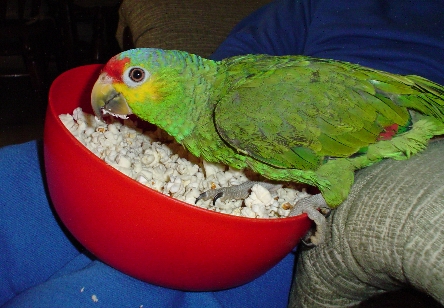
tequilapalomitas.jpg

The question I’d just asked was about his preferred foods. I was secretly hoping to hear that he ate a sunflower seed only diet, because this is the pinnacle of poor nutrition for the average parrot and was quite popular 30 years ago when most birds were imported and went through the rigors of quarantine stations before finding their way into homes. Thousands of parrots seemed to subsist on sunflower seed alone, whose nutritional value, though high in protein and fats, was loathsomely deficient in calcium and other life-sustaining vitamins and nutrients. 

The secret card up my sleeve? African Grey parrots, both the Congo species and their smaller cousins the Tymneh, were unusually susceptible to severe sickness from hypocalcemia. In addition to building strong bones, calcium is needed for all muscle contractions, including the heart muscle, and low calcium led to seizures or tetany and cardiac arrest. The treatment was simply supplying calcium and a little vitamin D to the afflicted parrot and most would turn around. The stuff of miracles and who doesn’t want to see a miracle?

But this woman! What was she saying? Forget seeds. Her bird subsisted on caramel corn? Peanut M&M’s? Pizza? Impossible that this bird could survive the high salts and fats and sugars of this diet! Let alone live to 42 years of age. But here he was. Although, as I knelt to get a closer view, one could not say that he was “living.” Not yet dead was more accurate. Gingerly I opened the cage door and slowly pulled him out. Joe didn’t move. I finally placed my stethoscope to his chest without disturbing his position on the towel. Oh dear. He had a heart murmur and his heart was beating very erratically. Cardiac arrhythmia. His abdomen bulged ominously. A tumor? The case was hopeless. The bird had never been to a veterinarian before and this was clearly too little, too late.

Which I tried to explain to his owner. We could do diagnostic tests, but he might die while we were trying to help him. The tests would be expensive and some would take a day or more to get results. I didn’t think he’d live long enough to find out what was killing him, let alone help him. I hate cases like this.

Joe’s owner requested that we proceed.

We placed him in an oxygen cage. Then, using gas anesthesia, we let him breathe himself into a state of non-painful peace and took x-rays, drew blood, obtained culture samples and tapped his abdomen (abdomenocentesis). No tumor. Joe appeared to be in congestive heart failure. What’s more, he woke up. I had given him several medications while he was still out and he remained on supplemental oxygen. Fast forward 24 hours. Joe is standing, a little wobbly, and has lost 50 grams of retained fluid overnight (10 percent of his entry weight). His blood calcium test is normal. Too weak to eat well on his own, we gavage fed him, using a tube to place baby mush directly into his crop. Fast forward 72 hours. Joe is talking, grooming himself and cracking seed. We take him off oxygen. On Day Five I sit down with his owner and explain that against all odds, her bird is adjusting well to oral medication and can go home. He will need medication the rest of his life. Given the seriousness of his condition, I tell her each day is a blessing. This is good enough for Joe and his owner.

We stayed in touch. Joe continued to improve. On Day 10 his owner happily reported that Joe was eating caramel corn again. Tongue-tied, I pulled back and stared at the phone. Not the goal I had in mind. I kept quiet. It’s been more than one month since I first met Joe. He is doing very well on his heart medications. I may start eating caramel corn myself.

Christine McFadden, DVM

Send questions or comments to drmc@mcmenagerie.com
Weight Loss Dreams

Myrtle had lost 8 pounds. I was most impressed. A middle-aged Australian Shepherd, she’d never had puppies, so couldn’t excuse her mid-life spread by pointing out her gorgeous offspring. Myrtle had been spayed young, which virtually guaranteed that she would not contract breast cancer in her lifetime (a 1-in-4 risk for older intact female dogs). This also meant she couldn’t drum up excuses about hormonal changes late in life. No, sadly, Myrtle would garner no awards for discovering the mystery behind unwanted weight gain : too many calories in, not enough burned off. In short, Myrtle over-ate and slept in. “Exercise” was not in her vocabulary.


When you realize that she had stuffed 73 pounds into a 50 pound body frame, you might begin to understand the concern. A young dog that is overweight can usually bear the extra pounds with grace. They are active, if perhaps less agile than a truly fit play mate. But look ahead : after years of joints and body parts groaning under those extra pounds, you will find this same pet to be suffering from arthritis at a much younger age than its counterparts. The overweight dog faces their senior years plagued with creaky knees and groaning hips. Yes, we have bunches of medications to come to their aid – an arsenal of anti-inflammatories, analgesics (an analgesic is a straight pain medication that is meant to mask the pain but does nothing to change the underlying condition, does not reduce inflammation, etc), dietary supplements, omega this and that – and they work. They do. But NO pill helps a suffering obese dog as much as taking that extra weight off. The weight loss can’t reverse the damage already done, but it will significantly reduce the everyday burden and muscle strain required to move the body.


As a group veterinarians are seeing obesity with increasing frequency in pets of all kinds. Diabetes mellitus (sugar diabetes) is on the rise, as are heart disease, exercise intolerance and heat stroke.


We feed our dogs too much, too often. I would like to think that the man who assured me he fed his dog only doughnuts was kidding. I understand the desire to share food with those we love. At our veterinary clinic we stock a low cal treat in each exam room. They gum up like rice cakes and average about 3 calories each. No, I don’t suppose anyone would chose it over bacon, but my patients on the whole accept them. The Disney stickers we used to hand out were a little dry going down. We serve treats because we hope our patients have a pleasant experience. We understand what you’re going through.


When meeting a pet who desperately needs to lose weight, I try to review the actual diet as fed at home. There have been some surprises over the years. Dental chews help keep teeth healthy. Bonus! Because most people do not brush their dog’s teeth. But we found some of those chews had up to 50 calories each – which for a tiny dog leading a “lapdog” life could account for 1/5th of their total recommended daily caloric intake! Dog food companies have been slow to publish the calorie count of many of their foods. If found, it will read as “Kcal” or kilocalorie, which is the same as “calorie” in everyday life.


So-called “lite” or healthy-weight or weight-management diets can have widely varying calorie counts. Get that information, calories (Kcal) per cup, before choosing which food is best for your pet. Extra fiber will fill up the stomach, helping your dog feel satisfied with smaller meals. Your veterinarian is always there to help. Blood tests can be checked to rule out underlying health issues, and we offer assistance with prescription weight loss foods and plans that really work – if followed.


We strive for balance. As long as we count the gummy bear and the cocktail peanuts, we can help you make the life plan work. Because at the end of the day, the real reward is talking to Myrtle’s owner and hearing her say in wonder : “It’s as if she’s 2 years younger. I’m getting my dog back.”


Christine B. McFadden, DVM

drmc@mcmenagerie.com

Close Associations

Dr Mc Blog

May 8, 2014

So you think it would be nice to have a veterinarian in the family? Sort of like deciding to take a family vacation by car, this sort of expressed wish is not made with a full deck. Close association with a veterinarian would bring you to your senses.

Veterinarians are lousy companions at dinner. First, I always forget that when someone asks me how my day went, they don’t REALLY want to know. I’m usually well into the second abscess or the ruptured intestine before I realize this, however, and by then I’ve spoiled someone’s appetite for the creamed soup. A veterinarian’s sense of humor is distorted, too. I’ve been at dinner tables where a veterinarian felt compelled to name the steak by its place of origin. Hard to feel the same about your meal after that. And those emergency calls that come so inconveniently! In my case, when invited as a guest, it seems someone always has a constipated kitten to discuss in vivid detail, usually on a phone adjacent to the dining room. Whispering about constipation can make people on both ends of the line think you’re weird.

And don’t forget: veterinarians aren’t trained to do much else. I may be able to place a metal pin in the shaft of a broken bone but don’t ask me to hammer a picture hangar into the wall. When someone talks about using a stud finder I automatically direct them to the local kennel club.

We’ve been known to bring sick animals home and plant them in the bathroom for observation. If the spouse forgets this in the middle of the night some unpleasantness may ensue. How many heads roll depends on whether the spouse stepped in the dog’s poop or just flat out took a flier over the darned thing into the nearest wall.

If you still think you’d like a vet in the family year-round, consider these stories: Much to her mother’s distress, I know a veterinarian (not me) who sewed up the hem on her bridesmaid dress with 2-0 suture using a simple interrupted pattern. And another who went to a Halloween party in a brown paper bag with plastic baggies of mayonnaise stapled to it – he was an abscess. Though veterinarians may not come home covered in grease, expensive 3-piece suits are also out and what they do wear is often covered in muck (I can be more precise). At the end of the day, many a vet feels as if they could substitute for the local fire hydrant.

And finally, what family would rush to take in someone who talks to animals (in public!)? This explains why so few full-fledged veterinarians are adopted – most of us started out in normal, unsuspecting families and by the time they knew where we were headed it was too late.

P.S. Both my mother and husband accept care packages.


Christine B. McFadden, DVM
drmc@mcmenagerie.com


Humor On The Job

Dr Mc Blog

May 4, 2014

After years of working together my staff has a few stories to tell.

Like about the crazy cat that bolted from her carrier like a wild thing (“oh, I should have told you she’s never been touched before. We had to put her food in there to catch her….”) and raced across the hospital to seek refuge in the staff break room. And jumped up onto the microwave. Which was in use, warming up some hot cocoa. In her distress the cat released her bladder…which dribbled into the microwave…which smoked and fizzled….and smelled. Probably forever, we don’t really know. We threw it out that very day. Some things you just don’t try to fix. (Except the cat. We “fixed” her. She did great!).

Or the day I gave up Ostrich Practice. Ostriches live in large fields like cows. They aren’t trained to lead on halters, you’re supposed to wait until one comes up to the fence to bite you out of curiosity, grab its’ beak and swiftly pull a cut-off sweatshirt sleeve over their head – once blinded, they won’t move (I’m not kidding. I’ve really done this. Past tense). It was raining and very muddy, and this particular ostrich, though injured from a dog attack and “down”, struggled rather fiercely against the examination so that I had to straddle him for restraint. Among other problems the ostrich had lice and shared some with me. I stopped off at the clinic long enough to glare at my staff, cancel my morning, and go home to clean up. Good news? Lice are “species-specific” parasites, meaning an ostrich louse may be able to run around on a person briefly but it can’t live and breed on you, so once picked off you’re clean. This is true for all types of louse or lice.

Then there was the episode of the Peach Parrot with diarrhea. A Moluccan Cockatoo weighing about 2 ½ pounds, “Peaches” was brought in because of the large puddles of poop she was passing, instead of the neat white and green droppings most birds have. Peaches was droopy and had lost weight, quietly squawking in pain when another puddle flowed out. She was ill enough that we hospitalized her while waiting for some lab test results to come back. Early the next morning I approached my patient in her incubator to see how she had fared overnight. Surprisingly, her bedding was clean. How could her diarrhea have cleared up overnight?  Hmmm. As much as I wish to see a strong response to treatment there was no real way to tell if the diarrhea had improved until I actually saw her droppings. Some birds will not go to the bathroom in their cage and will literally “hold it” until taken out in the morning.  I needed to see her fecal droppings. Hmmm. I examined the incubator floor again, noting a lot of cracked seed shells and some chewed up grapes. What goes in must come out, right? Now, I know a thing or two about birds and I know that most birds will defecate when picked up. So I opened the lid of the incubator, speaking gently to the bird while asking her to perch on my arm. I picked her up. Forgetful that the bird was fully flighted. Bird knew it. Bird took off. Peaches flew straight towards Jillian standing a few feet away. Jillian shrieked and dropped to the ground (anyone remember Alfred Hitchcock’s “The Birds”?). And, OF COURSE the bird flew right to her, landing on her prostrate back as Jillian buried her face in the floor (so the bird couldn’t pick out her eyeballs? Parrots don’t do that!). During the flapping and shrieking I attempted to reassure Jillian by yelling across the space “It’s ok, the bird’s nice!” (she was scaring my patient). Jillian remained (rather rigidly) face down, so I swooped over and re-perched the bird to return her to the incubator. Over my shoulder I heard a staff member assisting Jillian to her feet exclaim “Oh, let me clean that poop off!” I wheeled around and shouted “Wait! I need that!” Faces swiveled and stared at me. Dumbfounded, unbelieving silence. I faced them weakly. “I really need that sample” I begged, sort of inching my way towards the still crouched form of my employee. “Um, thanks” I said as I wielded a tongue depressor to obtain the desired sample.  To this day not a one of them glories in the case assistance given to help this bird. Jillian says she’s forgiven me but I noticed they moved the incubator far away from her work station.

Christine McFadden, DVM

drmc@mcmenagerie.com

My Own Christmas Holiday Moment…

So I’ll tell you how it all happened. This morning started with frozen water in my chickens’ feeder. I’m in a hurry (always), so I punch through the ice with my tippy fingers so Goldy and pals can have a drink and then hurry out to the car. My fingers are cold and hurt. The workday starts at the Applegate Zoo. We’re working in the deer pen today, a beautiful crisp, clear – and frigid – day. The new baby fawn is a dark chocolate color and in good health. But what with one thing and another I am running late. And my fingers are still very cold. So I suggest to my assistant, Tim, that we stop at the local Starbucks for a hot chocolate. What I’m late for back at the Clinic is mostly elective surgeries, so at worse I work through my lunch hour – no pets health is adversely affected. And I’m going to be chastised for being late regardless of whether I’m 15 minutes late or 25 minutes late. AND I’m very cold – did I mention that?

So I track down the local Starbucks. Find a parking spot RIGHT IN FRONT of the store! Lucky! Uhh-oh – no money. But handily I have Tim with me, and I beg for a loan (my treat, of course!).  Tim kindly agrees to cover me and in we go. Where I have to explain to the over-worked young man behind the counter that I don’t drink coffee (or frequent Starbucks) but I need something hot to warm up and do they have a hot chocolate with a hint of coffee flavor – decaf! – please? He authoritatively recommends and orders something for me, continuing on to explain and detail some drivel about taking a customer satisfaction survey after our order, with a bonus (!) coupon for some future visit. It involves computers. Fat chance. I’m not returning any time soon.

Tim places his order. That will be eight dollars and thirty cents. Tim hands over his card. Which doesn’t work. Twice. Uhh-oh. I mumble something about credit card payment over the phone? (I can call the Clinic, have someone go through my purse, call them back with my card number…). Nah, they’ve heard that scam before. I duck my head down and start to step out of line. But the nice young man behind the counter waves us down the aisle to pick up our order. What? He tells us the drinks are on him. WHAAAAT?

I assure him we will return to pay – he assures me that’s not necessary.

Our warm drinks, handmade (!) are delivered into our waiting hands. My fingers are instantly grateful. Ahhhh, warmth! With profuse thank-you’s, we slink out (thief!)… casually exiting the store to walk over to our, uh… Jag… and drive off.

Back at work, I fish a $20 bill out of my purse. This guy was extraordinary! I send Tim right back with the money and I jump into work. Tim returns. Apparently when he walked into the store to give our offering, the young man tried to refuse it. Tim insisted that he accept, saying he couldn’t return to work otherwise. He handed over the bill – and as he turned to leave, ran smack into a display shelf, knocking it over and sending a hundred items flying (Non-breakable! Luckily!). The portable shelf disintegrated into bits of pegs and plastic. Tim began to try to gather everything up. They asked him to please leave. Apparently we’d done enough for one day.

Thank you, Adrian of Starbucks! I was going to try to find that customer satisfaction form… but that requires a receipt… which you don’t get when you don’t pay for your drink. Instead, may I wish you a Merry Christmas! From my warmed fingers to your warm heart!

Let’s talk PDA’s…

Dr Mc Blog

So back in 2003 I started to date this guy that had been an attorney, and was now doing the family law judging in town. I don’t know about the rest of you, but I had happily stereotyped lawyers a long time ago, and though I even knew a few I’d call friend and neighbor, still… you know what I mean? But this man was genuinely nice, we’d been introduced through mutual friends, and on this particular evening he had invited me to a very nice Italian restaurant north of town. We muddled through a few topics during the appetizer, and just as the soup and salad course arrived it became difficult to overlook an overly affectionate couple at the next table. I shook my head and looked away. My date re-focused my attention on him, saying with enthusiasm “we need to discuss that!” I shook my head again, dismayed. “Discuss what?”

“PDA’s”, he said.

I stared, riveted in place. My jaw literally dropped. Patent Ductus Arteriosus?!? He had my full attention while I marveled at the RANGE of this man. In seconds I was reliving my first case in vet school, which involved a mother goat and her kid. The youngster was born with a heart defect, Patent Ductus Arterioisus or PDA. The condition is not that uncommon in newborns of any species: an embryonic blood vessel that bypasses the lungs while circulating blood through the heart in the unborn fetus (no air to breathe inside the womb!), it is supposed to close up just before birth. If this particular blood vessel or duct doesn’t close completely, you can hear a swooshy abnormal heart sound, or murmur, in the newborn and most importantly, if the retained embryonic vessel is very large, it will continue to bypass the lungs and the baby may not receive enough oxygenated blood! This can be a life- threatening condition. Happily, most will close on their own within 2 weeks of birth. I still encounter this condition occasionally in young puppies and kittens, and have even had to refer tiny patients to cardiac surgeons for life saving surgery.

It is an intense situation when encountered- and here was my date, delving deep into such an intense subject on a first date!

“Wow,” I said, leaning forward, now fully engaged in this conversation, “What did you want to talk about, when have you encountered this?”

“Well,” he gestured, “on dates.”

“Dates? Your dates have had heart problems?”

“What?”

We were both now staring at each other- (remember, this is early days, when you still give the benefit of the doubt to each other- you know, he seems like he can walk and chew gum at the same time; she appears to be able to navigate a room without falling off her heels – you are charitable). But?!?

I waded in again. “Aren’t you talking about Patent Ductus Arteriosus? A heart murmur in newborns?”

The man who would become my husband glared back, “No, I’m talking about Public Displays of Affection!”

Silence again as we contemplated each other.

“Oh. I’ve never heard of that before.” I mumbled, ” What kind of public displays of affection did you have in mind?”

Never mind. The zest for the topic was gone, and we segued into other, safer conversation.

Christine McFadden, DVM
drmc@mcmenagerie.com

Summer Hiatus

So all the plans for blogs, journaling and the excitement of a new web page were swept away – drowned, actually – in the wake of disturbance created by our new computer program! Indeed, summer seemed to get swept away. I have yet to find that computers are great time savers, though there is no denying that for retrieval of history they are awesome. As long as you input the data to begin with, that is. Oh. So having wrestled the new software into submission (we submitted, actually), we are now back at it. Hello, Blog!

And right there with us have been the chickens. So I conceived a wonderful idea (note light bulb over my head on your next visit): let’s get chickens! I have a small fruit tree orchard at home and am opposed to spraying pesticides and have noted over the years the slow but steady increase of insect varieties amongst my trees. Nothing terribly serious (until the cherry fruit fly moved in) but the trend was disturbing – I’m willing to share my fruit, but the bugs appeared to have their own agenda. And I’m not an entomologist! I’m saving my love for the pets! Hence nature’s little natural bug factory: chickens! Bonus: eggs!

Did you know they mail order day old chicks? They arrived at the post office safely, little peepers! A mixed variety of unusual breeds, all girly chicks because we only wanted “baking eggs” like you buy at the grocery store. No danger of cracking into the kind that might hatch… no need to traumatize children or ME. So we set up the little sweethearts and watched them GROW every DAY. It was amazing!

They got their own little coop and an exercise yard and fresh greens every day and… and… the incidental expenses can be overwhelming! But we really enjoyed our chicks in the Summer of the Computer and found their feathered baby antics quite soothing. It was a family affair – we took deck chairs out back to watch them. So I am now heartily recommending adding a few chickens to your yard – and once those eggs start coming, let me know if you’d like a few “baking eggs” – they’re a special kind that every family needs.

Christine McFadden, DVM

Are We Communicating, Doctor?

National Veterinary Technician Week

As a veterinarian I have been called upon to explore deeply into the human psyche. They never told me about this in vet school. My instructors cautioned against saying “oops” in the exam room, and pulling the ears too tightly on a pug-nosed bulging-eye breed of toy dog lest the eyeballs pop out (and yes, do you know it’s true? But I won’t tell about that one.). No, my teachers fell short in preparing me for the Late-Night-Emergency-Phone-Caller.

How would you respond to this call at quarter to eleven in the P.M., deep into REM sleep?

Veterinarian, “Hello?”

“Hello, Doctor? Meow, meow, meow. That’s what my kitty is saying. Meow, meow, meow…” (OK, I stopped counting. It went on for some time.) The voice on the telephone drew breath finally (one can only imagine her capacity under water), then queried, “Do you know what it is, Doctor?” I confess that I was at a diagnostic loss.

Then there was the time that an owner telephoned and wanted me to tell them if their pet was dead. The difficulty was that I had never seen their dog, and it was laying in their living room at home. Quoting a story from the “National Enquirer”, they were convinced that the pet was catatonic and might be buried alive. Convinced as they were, the question was surprisingly difficult to field. I’m ashamed to say that I finally told them to place the dog in a box and if it still hadn’t moved the next day or so I felt it would be okay to bury. Catatonic dogs were something else they didn’t discuss in vet school. It’s a subject I plan to take up with the dean.

Christine McFadden, DVM
DrMc@mcmenagerie.com